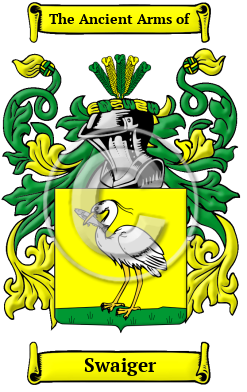
| ![Show Contents]() Swaiger History, Family Crest & Coats of Arms Swaiger History, Family Crest & Coats of Arms
- Origins Available:
Germany
Etymology of SwaigerWhat does the name Swaiger mean? The German surname Swaiger originated in the former duchy of Swabia, now the region of Baden-Wurttemberg. The name is derived from the Middle High German word "sweiger," meaning "one who operates a dairy farm." Swaiger is possibly also related to the Middle High German verb "sweigen," meaning "to make cheese." Alternatively, the name may be connected to the place name "Schwaig," the name of a city in Swabia. It is likely that the first bearers of the name were dairy farmers or residents of the city of Schwaig. Early Origins of the Swaiger familyThe surname Swaiger was first found in Wuerzburg, where the earliest recorded bearer of the name, Gottfried von Sweigere, was living in 1203. His son, Konrad Sweigere, is also on record as a resident of Wuerzburg in 1223. Early History of the Swaiger familyThis web page shows only a small excerpt of our Swaiger research. Another 112 words (8 lines of text) covering the years 1370, 1379, 1403, 1511, 1570, 1675 and 1758 are included under the topic Early Swaiger History in all our PDF Extended History products and printed products wherever possible. Swaiger Spelling VariationsSpelling variations of this family name include: Schwaiger, Swiger, Schweiger, Sweigere, von Sweigere, Schweier, Swaiger, Swigart, Swigard and many more. Early Notables of the Swaiger familythe Schwaigers, a family of goldsmiths working in Swabia from the fifteenth century, Johann Schweiger (1511-1570), a curate living in the principality Kulmbach Bayreuth, Johann Schwaiger, a...
Another 27 words (2 lines of text) are included under the topic Early Swaiger Notables in all our PDF Extended History products and printed products wherever possible. Migration of the Swaiger familySome of the first settlers of this family name or some of its variants were: Georg Swiger, whose family was among the original Protestant settlers who emigrated from Salzburg to Ebenezer, Georgia in 1733; Philip Swiger, who came to Philadelphia in 1741.
 |