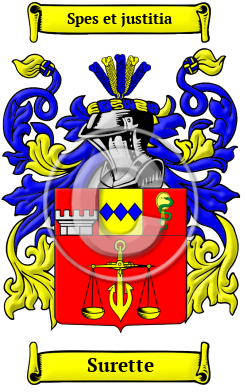
| ![Show Contents]() Surette History, Family Crest & Coats of Arms Surette History, Family Crest & Coats of Arms
Early Origins of the Surette familyThe surname Surette was first found in Burgundy (French: Bourgogne), an administrative and historical region of east-central France, where this family was established in earlier times. Early History of the Surette familyThis web page shows only a small excerpt of our Surette research. Another 101 words (7 lines of text) covering the years 1336, 1372, 1389, 1432, 1762, 1829 and 1845 are included under the topic Early Surette History in all our PDF Extended History products and printed products wherever possible. Surette Spelling VariationsSpelling variations of this family name include: Sirois, Sire, Lesire, Siret, Sirey, Siron, Sirot, Siraud, Siraut, Sirault, Sireau, Sireaux, Sirat, Syre, Syret, Syrey, Syron, Syrot and many more. Early Notables of the Surette familyAnother 38 words (3 lines of text) are included under the topic Early Surette Notables in all our PDF Extended History products and printed products wherever possible. Surette RankingIn the United States, the name Surette is the 17,530th most popular surname with an estimated 2,487 people with that name. 1
| Surette migration to the United States | + |
Surette Settlers in United States in the 20th Century- Thomas W. Surette, aged 48, who immigrated to America, in 1909
- Thomas Surette, aged 47, who immigrated to the United States, in 1910
- Thomas W. Surette, aged 48, who landed in America, in 1910
- Ada Surette, aged 40, who landed in America, in 1910
- Mary Surette, aged 44, who settled in America, in 1910
- ... (More are available in all our PDF Extended History products and printed products wherever possible.)
| Contemporary Notables of the name Surette (post 1700) | + |
- Robert R. M. "Rob" Surette (b. 1971), American speed-painter and public speaker
- Allister Wilbert Surette (b. 1961), Canadian politician and academic, President and Vice-Chancellor of Université Sainte-Anne (2011-)
- Pierre Surette (1709-1770), Acadian French resistance fighter against the British Empire
The motto was originally a war cry or slogan. Mottoes first began to be shown with arms in the 14th and 15th centuries, but were not in general use until the 17th century. Thus the oldest coats of arms generally do not include a motto. Mottoes seldom form part of the grant of arms: Under most heraldic authorities, a motto is an optional component of the coat of arms, and can be added to or changed at will; many families have chosen not to display a motto.
Motto: Spes et justitia
Motto Translation: Hope and Justice.
 |