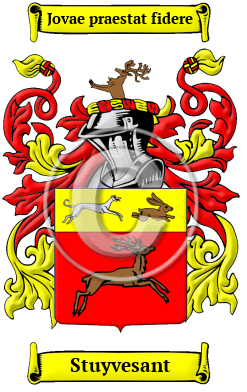
| ![Show Contents]() Stuyvesant History, Family Crest & Coats of Arms Stuyvesant History, Family Crest & Coats of Arms
- Origins Available:
Netherlands
Early Origins of the Stuyvesant familyThe surname Stuyvesant was first found in Holland, where the name became noted for its many branches in the region, particularly in Friesland. Each house acquired a status and influence which was envied by the princes of the region. The name was first recorded in Friesland, a province historically almost independent, but joined the Union of Utrecht to escape the tyranny of Spain. In the 17th and 18th centuries the house of Nassau-Siegen were stadtholders, but in 1748 William of Nasau-Siegen became Prince William IV of Orange and all the provinces. His grandson became William I, King of the Netherlands 1815. In their later history the name became a power unto themselves and were elevated to the ranks of nobility as they grew into this most influential family. Early History of the Stuyvesant familyThis web page shows only a small excerpt of our Stuyvesant research. Another 106 words (8 lines of text) covering the years 1610, 1672 and 1888 are included under the topic Early Stuyvesant History in all our PDF Extended History products and printed products wherever possible. Stuyvesant Spelling VariationsSpelling variations of this family name include: Stuyvesant, Steuvesant, Steubesand, Stòvesand, Stöwsand, Tuveson, Ruveson, Sturtevant and many more. Early Notables of the Stuyvesant family- Peter Stuyvesant (1610-1672), Dutch director-general of New Netherlands (New York)
| Stuyvesant migration to the United States | + |
Stuyvesant Settlers in United States in the 17th Century- Pieter Stuyvesant, who settled in New Netherland sometime between 1620 and 1664
- Grietie Stuyvesant, who arrived in New York in 1646 1
- Peter Stuyvesant, who landed in New York in 1646 1
- Pieter Stuyvesant, who arrived in New York, NY in 1647 1
- Peter Stuyvesant, who settled in Delaware Bay or River in 1647
- ... (More are available in all our PDF Extended History products and printed products wherever possible.)
| Contemporary Notables of the name Stuyvesant (post 1700) | + |
- Lewis Stuyvesant Chanler (1869-1942), American Democratic Party politician, Lieutenant Governor of New York, 1907-08; Candidate for Governor of New York, 1908 2
- Stuyvesant Fish (1851-1923), American president of the Illinois Central Railroad
- Stuyvesant Peabody, American Democratic Party politician, Delegate to Democratic National Convention from Illinois, 1932, 1952 (alternate) 3
The motto was originally a war cry or slogan. Mottoes first began to be shown with arms in the 14th and 15th centuries, but were not in general use until the 17th century. Thus the oldest coats of arms generally do not include a motto. Mottoes seldom form part of the grant of arms: Under most heraldic authorities, a motto is an optional component of the coat of arms, and can be added to or changed at will; many families have chosen not to display a motto.
Motto: Jovae praestat fidere
- Filby, P. William, Meyer, Mary K., Passenger and immigration lists index : a guide to published arrival records of about 500,000 passengers who came to the United States and Canada in the seventeenth, eighteenth, and nineteenth centuries. 1982-1985 Cumulated Supplements in Four Volumes Detroit, Mich. : Gale Research Co., 1985, Print (ISBN 0-8103-1795-8)
- The Political Graveyard: Alphabetical Name Index. (Retrieved 2015, November 3) . Retrieved from http://politicalgraveyard.com/alpha/index.html
- The Political Graveyard: Alphabetical Name Index. (Retrieved 2016, January 7) . Retrieved from http://politicalgraveyard.com/alpha/index.html
 |