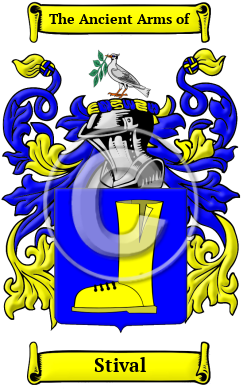
The distinguished and ancient German surname is of two possible origins. Firstly, it is derived from the German word "Stiefel," meaning "boot." In this instance, it is likely that the original bearer of the name was a boot-maker. Alternatively, the name may be derived from the Middle Low German term "stief," meaning "stiff, rigid, unbending." In this case, the name would have been initially bestowed as a nickname on someone who was particularly stiff or stubborn.
Loading...
Early Origins of the Stival family
The surname Stival was first found in Swabia, where it is thought to have first emerged. The young Stival family was instrumental during this formative period, figuring prominently in the early history of the region and contributing greatly to the development of medieval Swabian society.
Early History of the Stival family
This web page shows only a small excerpt of our Stival research. Another 158 words (11 lines of text) covering the years 1283, 1357, 1362, 1401, 1487, 1567 and 1847 are included under the topic Early Stival History in all our PDF Extended History products and printed products wherever possible.
Stival Spelling Variations
Spelling variations of this family name include: Stiefel, Stiefler, Stival, Stivel, Stiffler, Stiffle and many more.
Early Notables of the Stival family
Michael Stifel (1487-1567), a German priest and mathematician famous for introducing the modern notations for addition, subtraction, and square root, as well as for mathematically determining that Pope Leo X was the "Beast" referred to in the Book... Another 38 words (3 lines of text) are included under the topic Early Stival Notables in all our PDF Extended History products and printed products wherever possible.
Loading...
Loading...
Loading...
Loading...
Migration of the Stival family
Some of the first settlers of this family name or some of its variants were: Jacob Stiefel and his wife Catharina Stocker, who settled in Pennsylvania in 1730; Joh. Jacob Stiefel, a German Protestant living in South Carolina in 1788.