| ![Show Contents]() Steinere History, Family Crest & Coats of Arms Steinere History, Family Crest & Coats of Arms
- Origins Available:
Germany
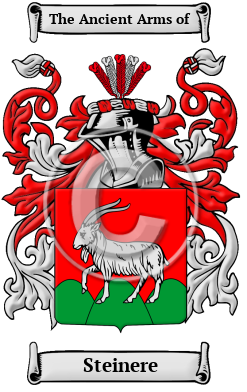
Etymology of SteinereWhat does the name Steinere mean? The long and noble heritage behind the name of Steinere first began in medieval Austria. While the patronymic and metronymic surnames, which are derived from the name of the father and mother respectively, are the most common form of a hereditary surname in Germany, occupational surnames also emerged during the late Middle Ages. Many people, such as the Steinere family, adopted the name of their occupation as their surname. However, an occupational name did not become a hereditary surname until the office or type of employment became hereditary. The surname Steinere literally means "stone" 1 and was an occupational name for a stone cutter. Further research revealed that the name is derived from the Old German word stein, meaning stone. In some cases the name may be topographical in nature and derive from the fact the original bearer lived near a prominent stone or rock. Early Origins of the Steinere familyThe surname Steinere was first found in Austria, in the cities of Berne and Neuchatel, where the name was anciently associated with the tribal conflicts of the area. They declared allegiances to many nobles and princes of early history, lending their influence in regional political struggles for power. They branched into many houses in Austria, and their contributions were sought by many leaders in their search for power. Early History of the Steinere familyThis web page shows only a small excerpt of our Steinere research. Another 128 words (9 lines of text) covering the years 1796, 1809, 1810, 1820, 1838, 1863 and 1935 are included under the topic Early Steinere History in all our PDF Extended History products and printed products wherever possible. Steinere Spelling VariationsMany cultural groups lived in the German states in medieval times. Each had its own dialect and traditions, and unique variations of popular names. Low German, which is similar to contemporary Dutch, was spoken in Westphalia. German names are characterized by additions such as regional suffixes and phrases that tell something about the origin or background of its original bearer. Further contributing to the variation in German names was the fact that there were no spelling rules in medieval times: scribes recorded names according to their sound. The recorded spelling variations of Steinere include Steiner, Steinert, Steinertz, Steinerth, Steinere, Stein, Steine and many more. Early Notables of the Steinere familyAnother 43 words (3 lines of text) are included under the topic Early Steinere Notables in all our PDF Extended History products and printed products wherever possible.
| Steinere migration to the United States | + |
After the First World War, Austria became a republic. The Treaty of Versailles broke up the empire in 1919 and many of the Sudeten Germans were incorporated into the new nation of Czechoslovakia. In the 20th century, many Austrians migrated to other parts of Germany or Europe, as well as to North America. In the United States, the majority of settlers landed in Philadelphia, and moved on to Ohio, Texas, Illinois, California, New York, and Maryland. Many German settlers also migrated to Canada, particularly Ontario and the Prairies. Amongst the settlers in North America with this distinguished name Steinere were
Steinere Settlers in United States in the 19th Century- John Steinere, who settled in New York City in 1822
- Bahlow, Hans, Dictionary of German Names. translated by Edda Gentry, Wisconsin: The Board of Regents of the University of Wisconsin System, 2002. Print. (ISBN 0-924119-35-7)
 |