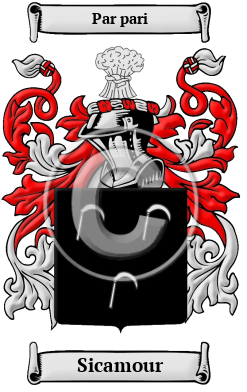
Sicamour is one of the names that was brought to England in the wave of migration following the Norman Conquest of 1066. The Sicamour family lived in Suffolk. Their name, however, translates as the dweller by the sycamore trees.
Loading...
Early Origins of the Sicamour family
The surname Sicamour was first found in Suffolk from very early times where they seated as Lords of the Manor of Wetheringsett. At the time of the taking of the Domesday Book in 1086 this village was the King's land, but was held by Godric and Ranulph, and conjecturally the Sicklemore family name is descended from this source.
Early History of the Sicamour family
This web page shows only a small excerpt of our Sicamour research. Another 121 words (9 lines of text) covering the years 1605, 1606, 1607 and 1610 are included under the topic Early Sicamour History in all our PDF Extended History products and printed products wherever possible.
Sicamour Spelling Variations
Before the advent of the printing press and the first dictionaries, the English language was not standardized. Sound was what guided spelling in the Middle Ages, so one person's name was often recorded under several variations during a single lifetime. Spelling variations were common, even among the names of the most literate people. Known variations of the Sicamour family name include Sicklemore, Siklemore, Sicamour, Sicamore, Sickelmore, Sicklemour, Sicklemere and many more.
Early Notables of the Sicamour family
John Sicklemore (died 1610), Governor of Virginia, possibly connected with the Suffolk family of Sicklemore, which was originally settled at Bramford, near Ipswich. "In early life he changed his name to Ratcliffe. In 1605 a Captain Ratcliffe, who may have been identical with John Sicklemore, served in the English auxiliary force employed in the Netherlands under Sir Horace Vere, and was taken prisoner in October at the battle of Mulheim with Sir Henry Cary and Captain Pigott. On 20 Dec. 1606 he sailed from London in command of the Discovery, a pinnace of 20 tons, in... Another 95 words (7 lines of text) are included under the topic Early Sicamour Notables in all our PDF Extended History products and printed products wherever possible.
Loading...
Loading...
Loading...
Loading...
Migration of the Sicamour family
To escape the political and religious chaos of this era, thousands of English families began to migrate to the New World in search of land and freedom from religious and political persecution. The passage was expensive and the ships were dark, crowded, and unsafe; however, those who made the voyage safely were encountered opportunities that were not available to them in their homeland. Many of the families that reached the New World at this time went on to make important contributions to the emerging nations of the United States and Canada. Research into various historical records has revealed some of first members of the Sicamour family to immigrate North America: James Sicklemore arrived in Barbados with his servants in 1680; Michael Sicklemore was one of the first settlers in Virginia in 1608; twelve years before the ".
The motto was originally a war cry or slogan. Mottoes first began to be shown with arms in the 14th and 15th centuries, but were not in general use until the 17th century. Thus the oldest coats of arms generally do not include a motto. Mottoes seldom form part of the grant of arms: Under most heraldic authorities, a motto is an optional component of the coat of arms, and can be added to or changed at will; many families have chosen not to display a motto.
Motto: Par pari Motto Translation: Equal to my equal.
Remove Item
WARNING!
Removing this item from your shopping cart will remove your associated sale items.
Are you sure you want to delete this item from your shopping cart?
HouseofNames E-Newsletter Sign Up
On Demand Gifts | Digital Products Available 24/7
A Gift for Everyone on your List is a Click Away - Shop Now