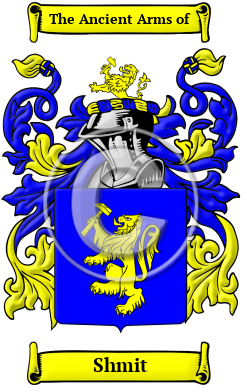
| ![Show Contents]() Shmit History, Family Crest & Coats of Arms Shmit History, Family Crest & Coats of Arms
- Origins Available:
Germany
Early Origins of the Shmit familyThe surname Shmit was first found in the northern provinces that were later to make up Prussia, where the name emerged in mediaeval times as one of the notable families of the region. Early History of the Shmit familyThis web page shows only a small excerpt of our Shmit research. Another 237 words (17 lines of text) covering the years 1537, 1564, 1618, 1630, 1648, 1708, 1752, 1764, 1766, 1768, 1787, 1815, 1817, 1837, 1838, 1849, 1853, 1854, 1875, 1876, 1880 and 1918 are included under the topic Early Shmit History in all our PDF Extended History products and printed products wherever possible. Shmit Spelling VariationsIn the medieval era, many different cultural groups lived in the German states. There are thus many regional variations of German surnames from that era. Westphalians spoke Low German, which is similar to modern Dutch. Many German names carry suffixes that identify where they came from. Others have phrases attached that identify something about the original bearer. Other variations in German names resulted from the fact that medieval scribes worked without the aid of any spelling rules. The spelling variations of the name Shmit include Schmidt (northern Germany), Schmid (southern Germany), Schmitz (Rhineland), Schmied, Schmitt, Smith (English) and many more. Early Notables of the Shmit familyBernhard Schmidt (1630-1708), known as "Father Smith", who was a famous organ builder; Georg Philipp Schmidt (1766-1849), known as "Schmidt from Luebeck", who was a physician and Romantic poet; Friederich Wilhelm Schmidt (1764-1838), who was a Prussian pastor and poet; Christoph von Schmid (1768-1854), Roman Catholic priest and writer of Christmas carols, who was ennobled in 1837; Hermann Theodor Schmid (1815-1880)...
Another 60 words (4 lines of text) are included under the topic Early Shmit Notables in all our PDF Extended History products and printed products wherever possible.
| Shmit migration to the United States | + |
Prussia played an extremely influential role in shaping modern German history. It remained a part of Germany until after the Second World War. Prussia was divided among the Soviet Union, Poland, East Germany and West Germany. Many Prussians became residents of these new countries after the War, and many migrated to other parts of Germany or Europe, as well as to North America. In the United States, the majority of settlers landed in Philadelphia, and moved on to Ohio, Texas, Illinois, California, New York, and Maryland. Many German settlers also migrated to Canada, particularly to Ontario and the Prairies. Amongst the settlers in North America with this distinguished name Shmit were
Shmit Settlers in United States in the 18th Century- Johan Jurch Shmit, who landed in New York in 1715-1716 1
- Conrad Shmit, who arrived in Pennsylvania in 1738 1
- Henry Shmit, who arrived in Pennsylvania in 1743 1
- Joh Donis Shmit, who landed in Pennsylvania in 1744 1
- Hans Adam Shmit, who arrived in Pennsylvania in 1750 1
- ... (More are available in all our PDF Extended History products and printed products wherever possible.)
- Filby, P. William, Meyer, Mary K., Passenger and immigration lists index : a guide to published arrival records of about 500,000 passengers who came to the United States and Canada in the seventeenth, eighteenth, and nineteenth centuries. 1982-1985 Cumulated Supplements in Four Volumes Detroit, Mich. : Gale Research Co., 1985, Print (ISBN 0-8103-1795-8)
 |