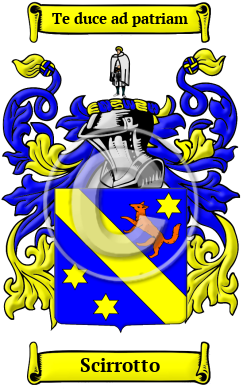
The surname Scirrotto was first found in Palermo (Sicilian: Palermu, Latin: Panormus), a city in Insular Italy, the capital of both the region of Sicily and the Province of Palermo at the foot of Mount Pellegrino, originally a Phoenician colony in the 3rd century B.C. Carthage and then the Saracens in 835 each occupied the city. The Norman period from 1050 was the most important and many ancient ruins exist from that time period. Two city gates still remain. The museum is notable and has many priceless relics. In those ancient times only persons of rank, the podesta, clergy, city officials, army officers, artists, landowners were entered into the records. To be recorded at this time, at the beginning of recorded history, was of itself a great distinction and indicative of noble ancestry.
Early History of the Scirrotto family
This web page shows only a small excerpt of our Scirrotto research. Another 134 words (10 lines of text) covering the years 1443, 1594 and 1609 are included under the topic Early Scirrotto History in all our PDF Extended History products and printed products wherever possible.
Scirrotto Spelling Variations
Spelling variations of this family name include: Scirotta, Scirotto, Sirotta, Sirotto and others.
Early Notables of the Scirrotto family
More information is included under the topic Early Scirrotto Notables in all our PDF Extended History products and printed products wherever possible.
Loading...
Loading...
Loading...
Loading...
Migration of the Scirrotto family
Some of the first settlers of this family name or some of its variants were: Antonio Scirotta, aged 24, who arrived at Ellis Island from Terranous in 1899; Nicolo Scirotta, aged 34, who arrived at Ellis Island from Rocchetta, Italy in 1913.
The motto was originally a war cry or slogan. Mottoes first began to be shown with arms in the 14th and 15th centuries, but were not in general use until the 17th century. Thus the oldest coats of arms generally do not include a motto. Mottoes seldom form part of the grant of arms: Under most heraldic authorities, a motto is an optional component of the coat of arms, and can be added to or changed at will; many families have chosen not to display a motto.
Motto: Te duce ad patriam Motto Translation: Both suffered the Walk
Remove Item
WARNING!
Removing this item from your shopping cart will remove your associated sale items.
Are you sure you want to delete this item from your shopping cart?