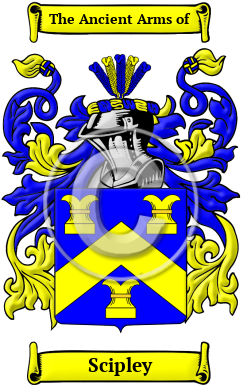
| ![Show Contents]() Scipley History, Family Crest & Coats of Arms Scipley History, Family Crest & Coats of Arms
- Origins Available:
England
Etymology of ScipleyWhat does the name Scipley mean? The ancestors of the Scipley family brought their name to England in the wave of migration after the Norman Conquest of 1066. They lived in Derbyshire, at Shipley, from where they derived their name. Alternatively, the name could have originated "from Shipley (pasture for sheep), the name of several places in England. " 1 Early Origins of the Scipley familyThe surname Scipley was first found in Derbyshire where they were granted the lands of Shipley, originally spelled Scipelie, by William the Conqueror for their assistance at the Battle of Hastings in 1066 A.D. Today Shipley is a township, in the parish of Heanor, union of Basford, hundred of Morleston and Litchurch. Shipley is also a township, in the parish of Eglingham, union of Alnwick, N. division of Coquetdale ward and of Northumberland and a parish, in the union of Horsham, hundred of West Grinstead, rape of Bramber, W. division of Sussex. 2 "The ancient castle of Knap, here, which appears to have been founded in an early period of the Norman era, was visited by King John in 1206 and 1215, and was garrisoned during the Parliamentary War." 2 One branch of the family may have originated in Shipley, a parish in West Riding of Yorkshire, three miles from Bradford or at Shepley, a township in the parish of Kirk Burton, West Riding of Yorkshire. Interestingly, the Yorkshire Shipley occurs as Scipeleia in Domesday Book of 1086. 3 "Both places seem to have been originally spelt Scheplay, so both Shepley and Shipley as surnames are now inextricably mixed." 4 And it is Yorkshire where we find the first records of the family. The Yorkshire Poll Tax Rolls of 1379 list Katerine de Scheplay; Joanna de Scheplay; and Adam de Scheplay as all holding lands there at that time. 4 Early History of the Scipley familyThis web page shows only a small excerpt of our Scipley research. Another 143 words (10 lines of text) covering the year 1769 is included under the topic Early Scipley History in all our PDF Extended History products and printed products wherever possible. Scipley Spelling VariationsA multitude of spelling variations characterize Norman surnames. Many variations occurred because Old and Middle English lacked any definite spelling rules. The introduction of Norman French to England also had a pronounced effect, as did the court languages of Latin and French. Therefore, one person was often referred to by several different spellings in a single lifetime. The various spellings include Shipley, Shiplie, Skiplie, Schipley and others. Early Notables of the Scipley familyMore information is included under the topic Early Scipley Notables in all our PDF Extended History products and printed products wherever possible. Migration of the Scipley familyMany English families left England, to avoid the chaos of their homeland and migrated to the many British colonies abroad. Although the conditions on the ships were extremely cramped, and some travelers arrived diseased, starving, and destitute, once in the colonies, many of the families prospered and made valuable contributions to the cultures of what would become the United States and Canada. Research into the origins of individual families in North America has revealed records of the immigration of a number of people bearing the name Scipley or a variant listed above: Thomas Shipley, with his wife Elizabeth, and son and daughter, who settled in Fort Cumberland, Nova Scotia, Canada, in 1774; Robert Shipley settled in Barbados in 1671.
- Smith, Eldson Coles, New Dictionary of American Family Names New York: Harper & Row, 1956. Print
- Lewis, Samuel, A Topographical Dictionary of England. Institute of Historical Research, 1848, Print.
- Harrison, Henry, Surnames of the United Kingdom: A Concise Etymological Dictionary Baltimore: Geneological Publishing Company, 2013. Print
- Bardsley, C.W, A Dictionary of English and Welsh Surnames: With Special American Instances. Wiltshire: Heraldry Today, 1901. Print. (ISBN 0-900455-44-6)
 |