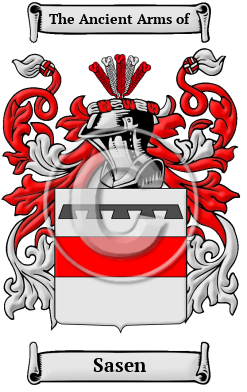
| ![Show Contents]() Sasen History, Family Crest & Coats of Arms Sasen History, Family Crest & Coats of Arms
- Origins Available:
Germany
Etymology of SasenWhat does the name Sasen mean? The name Sasen comes from the German region of Westphalia. The tradition of adopting hereditary surnames came to Germany after the 12th century, and the names of places where people lived were a primary source. Many local names carry the prefix "von", meaning "of" or "from". It originally indicated land ownership, and is sometimes a mark of nobility. The Sasen family originally lived in Saxony. The original bearer of the name Sasen was a person that was born or that had lived in the region of Lower (northern) Saxony, which is essentially the modern German state named Saxony. This name would have been given to the original bearer of the name after they had migrated from Lower Saxony to another region of Germany, namely Westphalia. The Saxons, who were a Germanic tribe, dwelled in northern Germany and along the Baltic coast during the Roman era. After the fall of the Roman Empire, the Saxons migrated south and west. By the 5th century, the Saxon and Angle tribes held most of England. The Saxon language became one of the precursors of the English language. Early Origins of the Sasen familyThe surname Sasen was first found in Westphalia, where this family name became a prominent contributor to the development of the district from ancient times. Always prominent in social affairs, the name became an integral part of that turbulent region as it emerged to form alliances with other families within the Feudal System and the nation. Early History of the Sasen familyThis web page shows only a small excerpt of our Sasen research. Another 142 words (10 lines of text) covering the years 1779 and 1814 are included under the topic Early Sasen History in all our PDF Extended History products and printed products wherever possible. Sasen Spelling VariationsIn the medieval era, many different cultural groups lived in the German states. There are thus many regional variations of German surnames from that era. Westphalians spoke Low German, which is similar to modern Dutch. Many German names carry suffixes that identify where they came from. Others have phrases attached that identify something about the original bearer. Other variations in German names resulted from the fact that medieval scribes worked without the aid of any spelling rules. The spelling variations of the name Sasen include Sasse, Sass, Sasser, Sase, Saser, Sassen, Sasen, Zasse, Zasser and many more. Early Notables of the Sasen familyAnother 29 words (2 lines of text) are included under the topic Early Sasen Notables in all our PDF Extended History products and printed products wherever possible.
| Sasen migration to the United States | + |
For many Germans, emigration to North America was an inviting alternative to the trials of life in the old country. From the mid-17th into the present century, thousands of Germans migrated across the Atlantic. They capitalized on the chance to escape poverty and persecution, and to own their own land. After 1650, Germans settled throughout the states of Pennsylvania, Texas, New York, Illinois, and California. Many also landed in Canada, settling in Ontario or father west on the rich land of the prairies. Among them:
Sasen Settlers in United States in the 18th Century- Francis Sasen, who landed in Virginia in 1708 1
- Filby, P. William, Meyer, Mary K., Passenger and immigration lists index : a guide to published arrival records of about 500,000 passengers who came to the United States and Canada in the seventeenth, eighteenth, and nineteenth centuries. 1982-1985 Cumulated Supplements in Four Volumes Detroit, Mich. : Gale Research Co., 1985, Print (ISBN 0-8103-1795-8)
 |