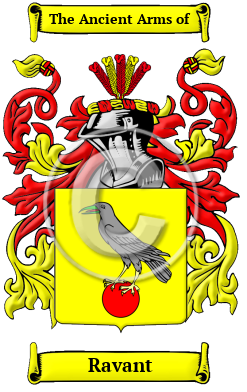
| ![Show Contents]() Ravant History, Family Crest & Coats of Arms Ravant History, Family Crest & Coats of Arms
Etymology of RavantWhat does the name Ravant mean? The name Ravant was carried to England in the enormous movement of people that followed the Norman Conquest of 1066. It comes from the Old English given name Raven. This name is a variation of the Old English word Hroefn, which indicated the large black bird we now call the raven, and was sometimes used as a nickname for someone with very dark hair. "Among the spoil taken by the Saxons was the famous banner of the Raven, said to have been woven in one day by the sisters of Inguar and Ubba, and to have possessed the property of appearing before every battle flying like a living bird if the Danes were to be victorious; while in the contrary event it hung down motionless." 1 Early Origins of the Ravant familyThe surname Ravant was first found in Leicestershire where the Domesday Book of 1086 "presents us with a tenant in chief called Raven-a true Scandinavian, doubtless. Rafn still exists in Denmark as a personal name, and is borne as a surname." 2 Continuing from the aforementioned Domesday Book reference, researchers found the History and Antiquities of the County Palatine of Durham referencing the name as a forename: Raven de Slinghawe, 1155. In the source, Hodgson's Northumberland, researchers found Gospatric filius Raven, 1177, William Raven, 1190 and Raven de Riding, 1233. The Hundredorum Rolls of 1273 listed Henry Raven, Cambridgeshire. 3 Early History of the Ravant familyThis web page shows only a small excerpt of our Ravant research. Another 85 words (6 lines of text) covering the year 1086 is included under the topic Early Ravant History in all our PDF Extended History products and printed products wherever possible. Ravant Spelling VariationsAnglo-Norman names are characterized by a multitude of spelling variations. When the Normans became the ruling people of England in the 11th century, they introduced a new language into a society where the main languages of Old and later Middle English had no definite spelling rules. These languages were more often spoken than written, so they blended freely with one another. Contributing to this mixing of tongues was the fact that medieval scribes spelled words according to sound, ensuring that a person's name would appear differently in nearly every document in which it was recorded. The name has been spelled Raven, Ravens and others. Early Notables of the Ravant familyMore information is included under the topic Early Ravant Notables in all our PDF Extended History products and printed products wherever possible. Migration of the Ravant familyFor many English families, the political and religious disarray that plagued their homeland made the frontiers of the New World an attractive prospect. Thousands migrated, aboard cramped disease-ridden ships. They arrived sick, poor, and hungry, but were welcomed in many cases with far greater opportunity than at home in England. Many of these hardy settlers went on to make important contributions to the emerging nations in which they landed. Among early immigrants bearing the name Ravant or a variant listed above were: Peter Raven, who settled in Virginia in 1648; Mary Raven, who settled in Barbados in 1664; John and Jane Raven, and their four daughters, who settled in Maryland in 1672.
- Harrison, Henry, Surnames of the United Kingdom: A Concise Etymological Dictionary Baltimore: Geneological Publishing Company, 2013. Print
- Lower, Mark Anthony, Patronymica Britannica, A Dictionary of Family Names of the United Kingdom. London: John Russel Smith, 1860. Print.
- Bardsley, C.W, A Dictionary of English and Welsh Surnames: With Special American Instances. Wiltshire: Heraldry Today, 1901. Print. (ISBN 0-900455-44-6)
 |