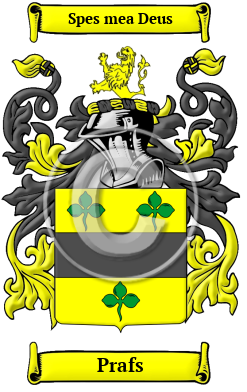
| ![Show Contents]() Prafs History, Family Crest & Coats of Arms Prafs History, Family Crest & Coats of Arms
- Origins Available:
France
Etymology of PrafsWhat does the name Prafs mean? The region of ancient France known as Auvergne is where the name Prafs was born. Prafs was a name for someone who lived in the modern administrative departments of Cantal and Puy-de-Dôme. While the old provinces were divided into the current "departments" in 1790, almost all of the French refer to themselves as if they were still resident in the medieval province instead of the current department. Early Origins of the Prafs familyThe surname Prafs was first found in Auvergne, a historic province in south central France where the family has been traced from early times. Early History of the Prafs familyThis web page shows only a small excerpt of our Prafs research. Another 193 words (14 lines of text) covering the years 1243, 1463, 1495, 1507, 1515, 1525, 1527, 1530, 1535, 1547, 1583, 1662 and 1729 are included under the topic Early Prafs History in all our PDF Extended History products and printed products wherever possible. Prafs Spelling VariationsThe many different spellings of French surnames can be partially explained by the use of local dialects and by the influence of other languages during the early development of the French language. As a result of these linguistic and cultural influences, the name Prafs is distinguished by a number of regional variations. The many spelling variations of the name include Prat, Prats, Pras, Prate, Prates, Pratte, Prattes, Prad, Prads, Prade, Prades, Praf, Prafs, Prafe, Prafes, Praffe, Praffes, Prap, Praps, Prape, Prapes, Prappe, Prappes, DuPrat, De la Prat, DePrat, Deprat, De Prat, du Prat and many more. Early Notables of the Prafs familyMore information is included under the topic Early Prafs Notables in all our PDF Extended History products and printed products wherever possible. Migration of the Prafs familyFrench settlers came early to North American, following in the wake of the explorers, and creating New France. Quebec City, founded in 1608 by Samuel de Champlain is said to have been the first American site founded as a permanent settlement, rather than as just a commercial outpost. But emigration was slow, in 1643, 109 years after the first landings by Cartier, there were only about 300 French people in Quebec, and by 1663, when the region was officially made The Royal Colony of New France, by Louis XIV, there still only around 500 settlers. Over 2,000 would arrive during the next decade. Early marriage was desperately encouraged amongst the immigrants. Youths of 18 took fourteen-year-old girls for their wives. The fur trade was developed and attracted immigrants, both noble and commoner from France. By 1675, there were around 7000 French in the colony, and by that same year the Acadian presence in Nova Scotia, New Brunswick and Prince Edward Island had reached 500. In 1755, 10,000 French Acadians refused to take an oath of allegiance to England and were deported to Louisiana. Despite the loss of the Colony to England, the French people flourished in Lower Canada. Among settlers to North America of the Prafs surname were Jacques Prate settled in Philadelphia in 1832; John Prat settled in Virginia in 1607.
The motto was originally a war cry or slogan. Mottoes first began to be shown with arms in the 14th and 15th centuries, but were not in general use until the 17th century. Thus the oldest coats of arms generally do not include a motto. Mottoes seldom form part of the grant of arms: Under most heraldic authorities, a motto is an optional component of the coat of arms, and can be added to or changed at will; many families have chosen not to display a motto.
Motto: Spes mea Deus
Motto Translation: God is my hope.
 |