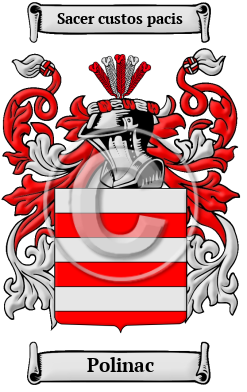
| ![Show Contents]() Polinac History, Family Crest & Coats of Arms Polinac History, Family Crest & Coats of Arms
- Origins Available:
France
Etymology of PolinacWhat does the name Polinac mean? A French family in the ancient region of Auvergne was the first to use the name Polinac. Polinac was a name for someone who lived in the south central part of the country. It has since been subdivided into the administrative departments of Cantal and Puy-de-Dôme. Early Origins of the Polinac familyThe surname Polinac was first found in Auvergne, a historic province in south central France. Early History of the Polinac familyThis web page shows only a small excerpt of our Polinac research. Another 168 words (12 lines of text) covering the years 1661, 1742, 1780, 1829 and 1847 are included under the topic Early Polinac History in all our PDF Extended History products and printed products wherever possible. Polinac Spelling VariationsMost surnames have experienced slight spelling changes. A son may not chose to spell his name the same way that his father did. Many were errors, many deliberate. During the early development of the French language, a person usually gave his version, phonetically, to a scribe, a priest, or a recorder. Prefixes or suffixes varied. They were optional as they passed through the centuries, or were adopted by different branches to signify either a political or religious adherence. Hence, there a many spelling variations of the name Polinac, including Polignac, Polignaque, Poligna, Polignak, Polinac, Polinaque, Polinak, Polinack and many more. Early Notables of the Polinac familyMore information is included under the topic Early Polinac Notables in all our PDF Extended History products and printed products wherever possible. Migration of the Polinac familyMigration from France to New France or Quebec as it was now more popularly called, continued from France until it fell in 1759. By 1675, there were 7000 French in Quebec. By the same year the Acadian presence in Nova Scotia, New Brunswick and Prince Edward Island had reached 500. In the treaty of Utrecht, the Acadians were ceded by France to Britain in 1713. In 1755, 10,000 French Acadians refused to take an oath of allegiance to England and were deported. They found refuge in Louisiana. In 1793, the remaining French in these provinces came under British rule. Meanwhile, in Quebec, the French race flourished, founding in Lower Canada, one of the two great solitudes which became Canada. Many of this distinguished family name Polinac were prominent in social, cultural, religious and political affairs in France and New France. Amongst the settlers in North America with this distinguished name Polinac were Jean-Baptiste Poligny, who was married in Montreal in 1743.
The motto was originally a war cry or slogan. Mottoes first began to be shown with arms in the 14th and 15th centuries, but were not in general use until the 17th century. Thus the oldest coats of arms generally do not include a motto. Mottoes seldom form part of the grant of arms: Under most heraldic authorities, a motto is an optional component of the coat of arms, and can be added to or changed at will; many families have chosen not to display a motto.
Motto: Sacer custos pacis
Motto Translation: Holy guardians of peace
 |