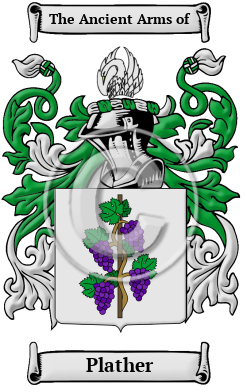
| ![Show Contents]() Plather History, Family Crest & Coats of Arms Plather History, Family Crest & Coats of Arms
- Origins Available:
Germany
Etymology of PlatherWhat does the name Plather mean? The German state of Prussia, which reached the zenith of its power in the late 19th century, is the glorious birthplace of the distinguished surname Plather. In the medieval era, after the fall of the Roman Empire, the German lands were inhabited by a variety of barbarian tribes. The borders of the barbarian kingdoms changed frequently, but the region that became known in Prussia was roughly divided between the areas of Brandenburg-Prussia, West Prussia, and East Prussia. The colorful history of Brandenburg-Prussia, provides a glimpse at the oldest origins of the Plather family. Early Origins of the Plather familyThe surname Plather was first found in Brandenburg, where the name was an integral part of a feudal society which would shape modern European history. Many prominent branches of the family would strive to make this name renowned as they contributed to the social, economic and political affairs of the region. Chronicles claim two different origins for this name. Some sources suggest that the origin is found in the mediaeval German word for the maker of breast plates for armor. This explanation is supported by the knight Otto cum Plata ("breast plate",) who lived at Ruegen around 1255. Other sources claim the name stems from the German word for "plateau." The famous Swiss humanist, Thomas Platter (1499-1582) wrote that "The Platters took their name from a house built upon a broad cliff edge." Early History of the Plather familyThis web page shows only a small excerpt of our Plather research. Another 269 words (19 lines of text) covering the years 1190, 1536, 1563, 1565, 1574, 1604, 1614, 1628, 1669, 1796 and 1835 are included under the topic Early Plather History in all our PDF Extended History products and printed products wherever possible. Plather Spelling VariationsMany cultural groups lived in the German states in medieval times. Each had its own dialect and traditions, and unique variations of popular names. Low German, which is similar to contemporary Dutch, was spoken in Westphalia. German names are characterized by additions such as regional suffixes and phrases that tell something about the origin or background of its original bearer. Further contributing to the variation in German names was the fact that there were no spelling rules in medieval times: scribes recorded names according to their sound. The recorded spelling variations of Plather include Plathner, Plath, Plathe, Plather, Plate, Plat, Plater, Platt, Platter, Platten, Platen, Platener, Platner, Plattener, Pletener, Plettener, Plaettner, Plaetner, Plaeth, Plett, Pletter, Pletten, Pleten, Pleter, Plettner, Blate, Blatte, Blatten and many more. Early Notables of the Plather familyThomas Platter, who was a prominent humanist from Basel. He began as an Alpine goatherd, then journeyed through Germany on foot and became a printer for Calvin. His elder son Felix Platter (1536-1614) was professor...
Another 35 words (2 lines of text) are included under the topic Early Plather Notables in all our PDF Extended History products and printed products wherever possible. Migration of the Plather familyMuch of German history has been shaped by the state of Prussia. It was an enduring military power until after the Second World War. At that time, the state was abolished altogether and its land divided between the Soviet Union, Poland, East Germany and West Germany. While some Prussians were content to remain in those countries, others moved away, many of them migrating to North America. They entered the United States mostly through Philadelphia, moving on to Ohio, Texas, Illinois, California, New York, and Maryland. Others went to Canada, settling on the prairies and in the province of Ontario. Among those of this surname listed in various historical records were: Richard Plat, who settled in Virginia in 1622. Gilbert Platt settled in Virginia in 1635; while Michael Platner came to Philadelphia in 1739; Elsbeth Plattner settled in Carolina or Pennsylvania in 1783.
 |