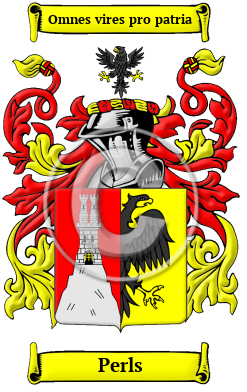
| ![Show Contents]() Perls History, Family Crest & Coats of Arms Perls History, Family Crest & Coats of Arms
Etymology of PerlsWhat does the name Perls mean? The distinguished and ancient German surname Perls is derived from "perle," meaning "pearl." The progenitor of the name was most likely someone who worked with pearls. Early Origins of the Perls familyThe surname Perls was first found in Bohemia, where the ancestral home of the Perls family is thought to be located. The young Perls family played an important role during these early formative years, contributing greatly to the development of medieval Bohemian society. Early History of the Perls familyThis web page shows only a small excerpt of our Perls research. Another 126 words (9 lines of text) covering the years 1386, 1406, 1751, 1773, 1798, 1839, 1866, 1877 and 1932 are included under the topic Early Perls History in all our PDF Extended History products and printed products wherever possible. Perls Spelling VariationsSpelling variations of this family name include: Perl, Perle, Perlmeister, Perlman, Perlmann, Perler, Perel, Perlmutter, Mutterperl, Perlmuter and many more. Early Notables of the Perls familyAnother 37 words (3 lines of text) are included under the topic Early Perls Notables in all our PDF Extended History products and printed products wherever possible. Migration of the Perls familySome of the first settlers of this family name or some of its variants were: Josef Perle, a Waldecker mercenary who settled in America after fighting in the Revolutionary War, Ernst Perl, who sailed with his family from Bremen to New York in 1857.
| Contemporary Notables of the name Perls (post 1700) | + |
- Frank Richard Perls (1910-1975), German-born American art dealer
- Nicholas Perls (1942-1987), the American founder and owner of Yazoo Records and Blue Goose Records
- Klaus Gunther Perls (1912-2008), born in Berlin, Germany, where his parents were art dealers
- Hugo Perls (1886-1977), German art dealer, historian, philosopher and notable collector
- Laura Perls (1905-1990), noted German-born psychologist
The motto was originally a war cry or slogan. Mottoes first began to be shown with arms in the 14th and 15th centuries, but were not in general use until the 17th century. Thus the oldest coats of arms generally do not include a motto. Mottoes seldom form part of the grant of arms: Under most heraldic authorities, a motto is an optional component of the coat of arms, and can be added to or changed at will; many families have chosen not to display a motto.
Motto: Omnes vires pro patria
Motto Translation: All my strength for my country
 |