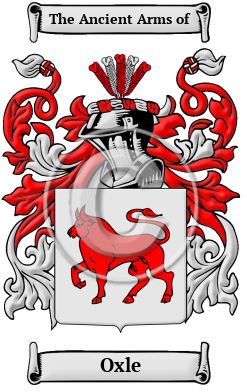
| ![Show Contents]() Oxle History, Family Crest & Coats of Arms Oxle History, Family Crest & Coats of Arms
- Origins Available:
Germany
Etymology of OxleWhat does the name Oxle mean? The Oxle surname first began to be used in the German state of Bavaria, some time after the 12th century, when hereditary surnames were adopted according to fairly general rules, and names that were derived from locations became particularly common. The family name Oxle is a local surname. Originally denoting the proprietorship of an estate or influence within a village, the German preposition von, which means from or of, used with local names, was taken as a mark of aristocracy. The surname Oxle was given to someone who lived in Franconia, where their name rose to prominence through their involvement in the social and cultural affairs of the area. Their seat and land holdings were in the free canton of Gebuerg. The ancestral home of the Oxle family is found in the Rhineland. Oxle is of several possible origins, all of which derive from a common root; the name comes from the Middle High German ochs, meaning "ox." It may have originated from a nickname, referring to "one as stubborn as an ox." Alternatively, the original bearer of the name may have been someone who kept or sold oxen. Finally, the surname may be derived from a place of residence distinguished by a sign; in this case, the name would indicate "one who dwelled in the house with the sign of the ox." Early Origins of the Oxle familyThe surname Oxle was first found in the Rhineland, where the Oxle family became a prominent contributor to the development of the district from ancient times. The earliest known bearer of the name was Hans Ochslin, who was a resident of Waldsee in 1536. Always prominent in social affairs, the young Oxle family became an integral part of that turbulent region as it emerged to form alliances with other families within the Feudal System and the nation. Early History of the Oxle familyThis web page shows only a small excerpt of our Oxle research. Another 155 words (11 lines of text) covering the years 1554, 1752, 1802, 1810 and 1821 are included under the topic Early Oxle History in all our PDF Extended History products and printed products wherever possible. Oxle Spelling VariationsOne can encounter great variation in the spelling of surnames: in early times, spelling in general, and thus the spelling of names was not yet standardized; and later, spellings would change with branching and movement of families. Variations of the name Oxle include Ochs, Ochss, Ochse, Och, Ochsse, Ocks, Ockss, Ockse, Ocksse, Osse (northern Germany), Oexle (Swabia), Oxle (Swabia), Oechsle, Ochsner, Exline, Echslin, Oxle, Ochslein ("little ox") and many more. Early Notables of the Oxle familyPeter Ochse from Gieselfeld (around 1554), a member of the Danish branch of the family who moved to Ravensburg where he became a major in the Bavarian army. According to Saxon chronicles, he played a key role in the service of King...
Another 41 words (3 lines of text) are included under the topic Early Oxle Notables in all our PDF Extended History products and printed products wherever possible. Migration of the Oxle familyThe great European flow of migration to North America, which began in the middle of the 17th century and continued into the 20th century, was particularly attractive to those from Bavaria who wished to escape either poverty or religious persecution. For many Bavarian tenant farmers, the chance to own their own land was a major incentive. So the widespread colonization of the United States began in 1650, when many immigrants from Germany settled in pockets in Pennsylvania, Texas, New York, Illinois, and California. In Canada, German settlement centered in Ontario and the prairie provinces. Among those of this surname listed in various historical records were: Christopher Exline, who settled in Philadelphia in 1743; Barbara Ochslin, who came to Georgia in 1750; Konrad Ochse, a Hessian mercenary who settled in America after fighting in the Revolutionary War, Nicolous Ochs, who was naturalized in Missouri in 1840.
 |