
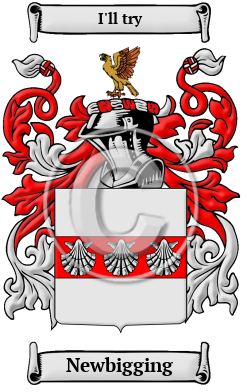
Show ContentsNewbigging History, Family Crest & Coats of Arms

Etymology of Newbigging

What does the name Newbigging mean?

The Newbigging surname is thought to be a habitational name taken on from any of several places so named in Northern England and Southern Scotland.

Early Origins of the Newbigging family

The surname Newbigging was first found in Berwickshire where the name is derived from the North England and Scottish word for a building or house. "Hence the phrase 'new biggin' was and is applied to any considerable edifice recently constructed. " 1 One of the first recordings of the name was when "the vill and lands of Newbigging in the parish of Camwath, Lanarkshire was passed into possession of the Somervilles through marriage with the daughter and heiress of Walter of Newbigging about middle of thirteenth century. Alan de Neubigging was one of twelve knights appointed in 1249 to meet twelve from Eng land to settle the law of the marches. " 2

Early History of the Newbigging family

This web page shows only a small excerpt of our Newbigging research. Another 131 words (9 lines of text) covering the years 1180 and 1367 are included under the topic Early Newbigging History in all our PDF Extended History products and printed products wherever possible.

Newbigging Spelling Variations

Spelling variations of this family name include: Newbigging, Newbiggin, Newbegin and others.

Early Notables of the Newbigging family

More information is included under the topic Early Newbigging Notables in all our PDF Extended History products and printed products wherever possible.

Migration of the Newbigging family

Some of the first settlers of this family name or some of its variants were: Edmund Newbigin, who arrived in Philadelphia in 1832; and N. Newbegin, who came to San Francisco in 1852.


Contemporary Notables of the name Newbigging (post 1700) +

  • David Newbigging, Chairman of Jardine Matheson


The Newbigging Motto +

The motto was originally a war cry or slogan. Mottoes first began to be shown with arms in the 14th and 15th centuries, but were not in general use until the 17th century. Thus the oldest coats of arms generally do not include a motto. Mottoes seldom form part of the grant of arms: Under most heraldic authorities, a motto is an optional component of the coat of arms, and can be added to or changed at will; many families have chosen not to display a motto.

Motto: I'll try


  1. Lower, Mark Anthony, Patronymica Britannica, A Dictionary of Family Names of the United Kingdom. London: John Russel Smith, 1860. Print.
  2. Black, George F., The Surnames of Scotland Their Origin, Meaning and History. New York: New York Public Library, 1946. Print. (ISBN 0-87104-172-3)


Houseofnames.com on Facebook