| ![Show Contents]() Mueller's History, Family Crest & Coats of Arms Mueller's History, Family Crest & Coats of Arms
Etymology of Mueller'sWhat does the name Mueller's mean? The Mueller's surname is thought to have originated in Bavaria, Germany. As hereditary surnames began to be adopted in that area beginning in the 12th century, people were often identified by the kind of work they did. Mueller's is an occupational name for a miller, derived from the Old Germanic "Mulinari." Early Origins of the Mueller's familyThe surname Mueller's was first found in Southern Germany, where they were established in the Middle Ages. The name is the German form of the Latin name "Molinarius," "Mulinari" in Old German. The modern form of the name, Mueller, is documented early on in the chronicles of Swabia, wherein the knight Conrad von Husen is noted as having become known as Mueller for his ownership of a mill. Early History of the Mueller's familyThis web page shows only a small excerpt of our Mueller's research. Another 239 words (17 lines of text) covering the years 1631, 1670, 1675, 1693, 1749, 1752, 1758, 1779, 1806, 1807, 1815, 1825, 1828, 1829 and 1846 are included under the topic Early Mueller's History in all our PDF Extended History products and printed products wherever possible. Mueller's Spelling VariationsIn the medieval era, many different cultural groups lived in the German states. There are thus many regional variations of German surnames from that era. Westphalians spoke Low German, which is similar to modern Dutch. Many German names carry suffixes that identify where they came from. Others have phrases attached that identify something about the original bearer. Other variations in German names resulted from the fact that medieval scribes worked without the aid of any spelling rules. The spelling variations of the name Mueller's include Mueller, Muller, Mueler, Muler, Miller, Moeller, Muellner, Milner, Molner and many more. Early Notables of the Mueller's familyHeinrich Müller (1631-1675) was a German devotional author, Protestant author of hymns and Lutheran theologian; Adam Heinrich Mueller (1779-1829), ennobled in 1828 as Ritter von Nittersdorf, who influenced Hegel and accompanied Metternich to Paris in 1815, Johann Matthias Mueller, a general in the Austrian army, who was ennobled in 1758, Friedrich Mueller (1749-1825), known as "Maler Mueller" ("painter Mueller"), a famous painter and writer who enjoyed the patronage of...
Another 69 words (5 lines of text) are included under the topic Early Mueller's Notables in all our PDF Extended History products and printed products wherever possible. Migration of the Mueller's familyThousands of German settlers came to North America between the mid-17th and mid-20th centuries. The hardships of the long voyage were balanced by the opportunity to escape poverty and religious persecution. The descendents of these settlers still populate the states of Pennsylvania, Texas, New York, Illinois, and California. Many also live in Ontario and the prairie provinces of Canada. An inquiry into the early roots of North American families has revealed a number of immigrants bearing the name Mueller's or a variant listed above: Jacob Mueller, who emigrated to America with his wife and five children in 1709; Hans Lendert Miller, who settled in Philadelphia in 1728; as did Heinrich Miller in 1740 and Adam Miller in 1754.
The motto was originally a war cry or slogan. Mottoes first began to be shown with arms in the 14th and 15th centuries, but were not in general use until the 17th century. Thus the oldest coats of arms generally do not include a motto. Mottoes seldom form part of the grant of arms: Under most heraldic authorities, a motto is an optional component of the coat of arms, and can be added to or changed at will; many families have chosen not to display a motto.
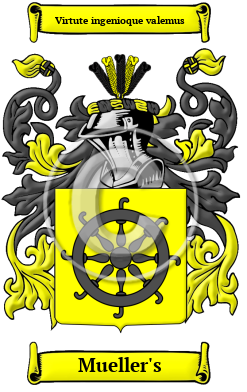
Motto: Virtute ingenioque valemus
Motto Translation: We are strong because our virtue and talent
 |