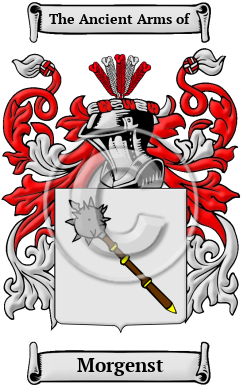
The name is derived from the Middle German words "morgen" meaning "morning" and "stern" meaning "star." Combined the name means "one who lived at the sign of the morning star."
Loading...
Early Origins of the Morgenst family
The surname Morgenst was first found in Anhalt, where the name could be considered to have made a great contribution to the feudal society which became the backbone of modern Europe. The family became prominent in local affairs and branched into many houses which played important roles in the tribal and national conflicts, in which each group sought power and status in an ever changing territorial profile. The name is derived from the Middle German words "morgen" meaning "morning" and "stern" meaning "star." Combined the name means "one who lived at the sign of the morning star."
Early History of the Morgenst family
This web page shows only a small excerpt of our Morgenst research. Another 164 words (12 lines of text) covering the years 1768, 1789, 1836, 1871 and 1914 are included under the topic Early Morgenst History in all our PDF Extended History products and printed products wherever possible.
Morgenst Spelling Variations
In the medieval era, many different cultural groups lived in the German states. There are thus many regional variations of German surnames from that era. Westphalians spoke Low German, which is similar to modern Dutch. Many German names carry suffixes that identify where they came from. Others have phrases attached that identify something about the original bearer. Other variations in German names resulted from the fact that medieval scribes worked without the aid of any spelling rules. The spelling variations of the name Morgenst include Morgenstern, Morgensterner and others.
Early Notables of the Morgenst family
Christian Morgenstern (1871-1914), who was the son of an artist from Breslau...
Loading...
Loading...
Loading...
Loading...
Migration of the Morgenst family
Since medieval times, the state of Prussia has played an important part in the history of Germany. The state's military powers were historically very strong, and endured until after the Second World War, when the territory was broken up and divided between the Soviet Union, Poland, East Germany and West Germany. A spurt of migration followed, with some Prussians going elsewhere in Europe and many others crossing the ocean to North America. Most entered the United States through Philadelphia. Some remained there, while more moved on to the states of Ohio, Texas, Illinois, California, New York, and Maryland. Others traveled to Canada and settled Ontario and the prairie provinces. Research into the origins of individual families in North America revealed records of the immigration of a number of people bearing the name Morgenst or a variant listed above: Calrl Friedrich (Captain) Morgenstern, a German mercenary, who was on record in Quebec in 1776; Johannes Morgenstern, who came to Philadelphia in 1728. Johann Engelbert Morgenstern came to Philadelphia in 1749.