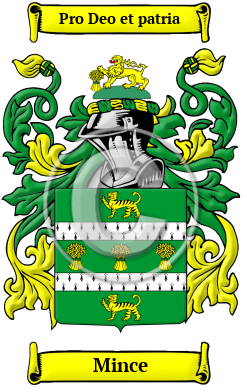
| ![Show Contents]() Mince History, Family Crest & Coats of Arms Mince History, Family Crest & Coats of Arms
- Origins Available:
England
Etymology of MinceWhat does the name Mince mean? The Mince surname was a habitational name taken from a place so named, in Shropshire. The placed name Minton is derived from the Welsh word "mynydd" meaning "hill," and the Old English word "tun," meaning "enclosure," or "settlement." 1 Early Origins of the Mince familyThe surname Mince was first found in Shropshire at Minton, a township, in the parish and union of Church-Stretton, hundred of Munslow. 2 The place name dates back to the Domesday Book of 1086 when it was first listed as Munetune. 3 There is another Minton in England. "Probably also some smaller spot in co. Northumberland. But this family has sprung from Shropshire." 4 The earliest record of the family was Walter de Muneton who was listed in the Select Pleas of the Forest for Shropshire in 1209. A few years later, Richard de Minton was listed in the Assize Rolls of Shropshire in 1221. 5 Early History of the Mince familyThis web page shows only a small excerpt of our Mince research. Another 87 words (6 lines of text) covering the years 1455, 1487, 1765 and 1836 are included under the topic Early Mince History in all our PDF Extended History products and printed products wherever possible. Mince Spelling VariationsSpelling variations of this family name include: Minton, Mineton, Mindton, Mindtown and others. Early Notables of the Mince familyAnother 44 words (3 lines of text) are included under the topic Early Mince Notables in all our PDF Extended History products and printed products wherever possible.
| Mince migration to the United States | + |
Mince Settlers in United States in the 18th Century- Michel Mince, aged 20, who arrived in Louisiana in 1720 7
| Mince migration to Australia | + |
Emigration to Australia included the Second Fleet of convicts, tradespeople and early settlers. Early immigrants include: Second Fleet - Mr. William Mince, British settler convicted in London, England in 1789, sentenced to 7 years for stealing, transported aboard the ship "Salamander" leaving in 1790 arriving in New South Wales, Australia in 1791 6
The motto was originally a war cry or slogan. Mottoes first began to be shown with arms in the 14th and 15th centuries, but were not in general use until the 17th century. Thus the oldest coats of arms generally do not include a motto. Mottoes seldom form part of the grant of arms: Under most heraldic authorities, a motto is an optional component of the coat of arms, and can be added to or changed at will; many families have chosen not to display a motto.
Motto: Pro Deo et patria
Motto Translation: For God and country.
- Mills, A.D., Dictionary of English Place-Names. Oxford: Oxford University Press, 1991. Print. (ISBN 0-19-869156-4)
- Lewis, Samuel, A Topographical Dictionary of England. Institute of Historical Research, 1848, Print.
- Williams, Dr Ann. And G.H. Martin, Eds., Domesday Book A Complete Translation. London: Penguin, 1992. Print. (ISBN 0-141-00523-8)
- Bardsley, C.W, A Dictionary of English and Welsh Surnames: With Special American Instances. Wiltshire: Heraldry Today, 1901. Print. (ISBN 0-900455-44-6)
- Reaney, P.H and R.M. Wilson, A Dictionary of English Surnames. London: Routledge, 1991. Print. (ISBN 0-415-05737-X)
- Convict Records of Australia. Retrieved 4th February 2021 from https://convictrecords.com.au/ships
- Filby, P. William, Meyer, Mary K., Passenger and immigration lists index : a guide to published arrival records of about 500,000 passengers who came to the United States and Canada in the seventeenth, eighteenth, and nineteenth centuries. 1982-1985 Cumulated Supplements in Four Volumes Detroit, Mich. : Gale Research Co., 1985, Print (ISBN 0-8103-1795-8)
 |