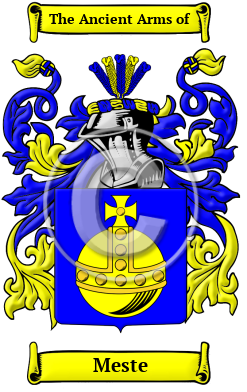
| ![Show Contents]() Meste History, Family Crest & Coats of Arms Meste History, Family Crest & Coats of Arms
- Origins Available:
Germany
Etymology of MesteWhat does the name Meste mean? During the Middle Ages, the surname of Meste was used in Austria. While the patronymic and metronymic surnames, which are derived from the name of the father and mother respectively, are the most common form of a hereditary surname in Germany, occupational surnames also emerged during the late Middle Ages. Many people, such as the Meste family, adopted the name of their occupation as their surname. However, an occupational name did not become a hereditary surname until the office or type of employment became hereditary. The surname Meste was an occupational name for a knife maker having derived from the Old German word messer, meaning knife. Early Origins of the Meste familyThe surname Meste was first found in Austria, where the name could be considered to have made a great contribution to the feudal society which became the backbone of modern Europe. Literally, the name could either mean "one who made knives and daggers," for "Metz" is the mediaeval form of "Messer," or it could mean "one who operates a mill," for "metze" was the medaieval weight scale for foodstuff such as corn and flour. Chronicles first mention one Peter mit der metzen of Glatz in 1356, and a "Mecze" who was the wife of Ramfold von Gersdorf in 1390. Metz is also the Germanized form of the Latin "Mediomatrica," a city on the Moselle River in what was once Westphalia, but is now France, which Caesar described as one of the oldest and most important towns of Gaul. The name "Metzer" then means "from the city of Metz." Strasbourg chronicles mention Conrad Metzer von Hagenau in 1295. The name became prominent in local affairs and branched into many houses which played important roles in the tribal and national conflicts, in which each group sought power and status in an ever changing territorial profile. Early History of the Meste familyThis web page shows only a small excerpt of our Meste research. Another 159 words (11 lines of text) covering the years 1787 and 1796 are included under the topic Early Meste History in all our PDF Extended History products and printed products wherever possible. Meste Spelling VariationsIn the medieval era, many different cultural groups lived in the German states. There are thus many regional variations of German surnames from that era. Westphalians spoke Low German, which is similar to modern Dutch. Many German names carry suffixes that identify where they came from. Others have phrases attached that identify something about the original bearer. Other variations in German names resulted from the fact that medieval scribes worked without the aid of any spelling rules. The spelling variations of the name Meste include Metz, Metzmacher, Metzner, Metze, Mets, Metsch and many more. Early Notables of the Meste familyAnother 39 words (3 lines of text) are included under the topic Early Meste Notables in all our PDF Extended History products and printed products wherever possible. Migration of the Meste familyAustria was made a republic after the First World War. The Austro-Hungarian Empire was broken up by the Treaty of Versailles and many of its people found themselves in the new nation of Czechoslovakia. Many other Austrians and expatriate Austrians made their way to North America in the 20th century. Most landed in Philadelphia, later continuing on to the states of Ohio, Texas, Illinois, California, New York, and Maryland. Some Austrian settlers also went to western Canada and Ontario. Research into the origins of individual families in North America revealed records of the immigration of a number of people bearing the name Meste or a variant listed above: Andrew Metz, his wife, and four children, Sebastian Metz, his wife, and three children, and Simon Metz with his wife and three children, all of whom emigrated to England and/or America in 1709. Numerous bearers of this name arrived in Philadelphia in the 1730s, and other wave arrived in Texas in the 1840s, among them being Johann Metz with his wife Caroline, Peter Metz with his wife Magda Dienemann, and Philip Heinrich Metz who came with his wife Marie Meyer. Balser Mets and Hans Jacob Mets came to Philadelphia in 1733.
 |