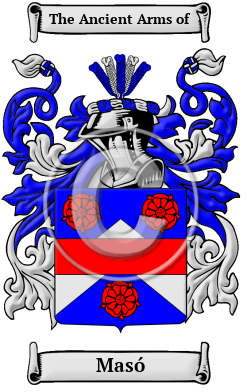
| ![Show Contents]() Masó History, Family Crest & Coats of Arms Masó History, Family Crest & Coats of Arms
Etymology of MasóWhat does the name Masó mean? The distinguished surname Masó can be traced back to the ancient and beautiful region of Piedmont. Although people were originally known only by a single name, it became necessary for people to adopt a second name to identify themselves as populations grew and travel became more frequent. The process of adopting fixed hereditary surnames was not complete until the modern era, but the use of hereditary family names in Italy began in the 10th and 11th centuries. Italian hereditary surnames were developed according to fairly general principles and they were characterized by a profusion of derivatives coined from given names. The most common type of family name found in the region of Piedmont is the patronymic surname, which is derived from the father's given name. During the Middle Ages, Italians adopted the patronymic system of name-making because it perfectly complemented the prevailing Feudal System. In Italy the popularity of patronymic type of surname is also due to the fact that during the Christian era, people often named their children after saints and biblical figures. The surname Masó came from the first-name Maso, which is the short form of the personal name Tommaso. The name Tommaso, or Thomas, is itself derived from the Aramaic "toma" which means "twin". Early Origins of the Masó familyThe surname Masó was first found in Piedmont (Italian: Piemonte, Piedmontese and Occitan: Piemont) in the 13th century where early records show the Masini family, decedents of a long line of counts, lived and whose members included Oddone, elected captain of the commune in 1284, and Oddonnino, governor of a town, Vercelli, in 1290. Early History of the Masó familyThis web page shows only a small excerpt of our Masó research. The years 1383 and 1401 are included under the topic Early Masó History in all our PDF Extended History products and printed products wherever possible. Masó Spelling VariationsEnormous variation in spelling and form characterizes those Italian names that originated in the medieval era. This is caused by two main factors: regional tradition, and inaccuracies in the recording process. Before the last few hundred years, scribes spelled names according to their sounds. Spelling variations were the unsurprising result. The variations of Masó include Masella, Maselli, Masellis, Masetti, Masetto, Masi, Masiello, Masillo, Masin, Masina, Masini, Masino, Masiol, Maso, Masolini, Masolo, Mason, Masoni, Masotti, Masselli, Massetti, Massini, Masucci, Masuccio, Masulli, Masullo, Masutti, Masutto and many more. Early Notables of the Masó family- members of the Masó family from the Piedmontese tradition include Tommaso Guidi Masaccio, who was born in 1401, and is a painter known as the Father of Modern Art...
- He was a student of Masolino and under this master, aided in the frescoing of two churches: San Clemente in Rome and the Brancacci Chapel in Santa Maria del Carmine at Florence...
- Also prominent in the 15th century was Masolino da Panicale, born in 1383, who was also a Florentine painter...
Masó RankingIn France, the name Masó is the 9,188th most popular surname with an estimated 500 - 1,000 people with that name. 1
| Masó migration to the United States | + |
Immigrants bearing the name Masó or a variant listed above include:
Masó Settlers in United States in the 19th Century- Miguel Garcia Maso, aged 46, who arrived in New Orleans, La in 1829 2
- B Maso, aged 38, who arrived in New Orleans, La in 1830 2
- Jose Maso, aged 25, who landed in New Orleans, La in 1846 2
| Contemporary Notables of the name Masó (post 1700) | + |
- Maso di Banco, Italian painter
- http://www.journaldesfemmes.com/nom-de-famille/nom/
- Filby, P. William, Meyer, Mary K., Passenger and immigration lists index : a guide to published arrival records of about 500,000 passengers who came to the United States and Canada in the seventeenth, eighteenth, and nineteenth centuries. 1982-1985 Cumulated Supplements in Four Volumes Detroit, Mich. : Gale Research Co., 1985, Print (ISBN 0-8103-1795-8)
 |