
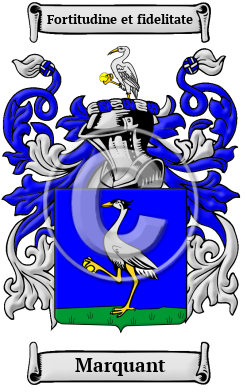
Show ContentsMarquant History, Family Crest & Coats of Arms

Etymology of Marquant

What does the name Marquant mean?

The Marquant surname comes from the Middle Low German words "mark," or "borderland," and "ward(e)" meaning "guardian." As such, it is thought to have originally been an occupational name for a guardian of border area.

Early Origins of the Marquant family

The surname Marquant was first found in Hessen, where the name was closely identified in the early period of history with the feudal society which would become prominent throughout Europe. The name would later emerge as an influential noble family, having many distinguished branches, and well known for its involvement in social, economic and political affairs.

Early History of the Marquant family

This web page shows only a small excerpt of our Marquant research. Another 93 words (7 lines of text) covering the years 1691, 1819 and 1861 are included under the topic Early Marquant History in all our PDF Extended History products and printed products wherever possible.

Marquant Spelling Variations

Spelling variations of this family name include: Marquard, Marquart, Marquarde, Marquardes, Marquards, Marquarte, Marquartes, Marquartts, Marquardds, Marquardt, Markard, Markhard and many more.

Early Notables of the Marquant family

More information is included under the topic Early Marquant Notables in all our PDF Extended History products and printed products wherever possible.

Marquant Ranking

France, the name Marquant is the 1,852nd most popular surname with an estimated 3,309 people with that name. 1


Marquant migration to the United States +


Marquant Settlers in United States in the 18th Century
  • Hugue Marquant, who settled in Louisiana in 1720
Marquant Settlers in United States in the 19th Century
  • Joseph Marquant, who settled in New York, NY in 1870
  • Therese Marquant, who settled in New York, NY in 1870


The Marquant Motto +

The motto was originally a war cry or slogan. Mottoes first began to be shown with arms in the 14th and 15th centuries, but were not in general use until the 17th century. Thus the oldest coats of arms generally do not include a motto. Mottoes seldom form part of the grant of arms: Under most heraldic authorities, a motto is an optional component of the coat of arms, and can be added to or changed at will; many families have chosen not to display a motto.

Motto: Fortitudine et fidelitate
Motto Translation: By fortitude and fidelity.


  1. http://www.journaldesfemmes.com/nom-de-famille/nom/


Houseofnames.com on Facebook