| ![Show Contents]() Marella History, Family Crest & Coats of Arms Marella History, Family Crest & Coats of Arms
Etymology of MarellaWhat does the name Marella mean? The Italian family name Marella is classified as being of personal name origin, as in the case of many family names this surname derives its origins from the given name of one of the parents of its initial bearer. The name Marella is most probably derived from a short form of the feminine version of the name Ademaro, Mara. To this name has been added the suffix "-ella" to form a pet name. In this case the surname is of matronymic origin and would mean "son of Mara". The root name "mare" also means "sea," denoting someone living by the sea. Alternatively, the surname may be of nickname origin, based on a physical characteristic or a personal attribute of the original bearer. Instances of names with this origin are based on the Italian regional words "amaru", "amaro" and "maru", which mean "affliction and pain"; evidently early bearers of this name were known to their contemporaries by the fact that they suffered some kind of misfortune. The word "amaro" is ultimately derived from the Hebrew "mara", which means "bitter". This name has also biblical associations, as Mara was the name taken by Naomi out of sorrow. Monte Morello is the highest mountain (934 m.) in the Florentine valley, Italy, located to the north-west of Florence. Early Origins of the Marella familyThe surname Marella was first found in Maglione (Piemonte), as records show some of the family were endowed with the title of Counts of Verde and Counts of Baio in the sixteenth century. In this case, the record shows the Marello spelling was used. Early History of the Marella familyThis web page shows only a small excerpt of our Marella research. The years 1852, 1872, 1882, 1922, 1929 and 1969 are included under the topic Early Marella History in all our PDF Extended History products and printed products wherever possible. Marella Spelling VariationsIn comparison with other European surnames, Italian surnames have a surprising number of forms. They reflect the regional variations and the many dialects of the Italian language, each with its own distinctive features. For example, in Northern Italy the typical Italian surname suffix is "i", whereas in Southern Italy it is "o". Additionally, spelling changes frequently occurred because medieval scribes and church officials often spelled names as they sounded rather than according to any specific spelling rules. The spelling variations in the name Marella include Marelli, Marello, Marella, Marela, Merello and others. Early Notables of the Marella family- Doña Gliceria Legaspi Marella de Villavicencio (1852-1929), also known as Aling Eralian, is one of the famous Filipinos who gave her own wealth, time, knowledge and effort to help the Revolutionaries...
- Olinto Marella (1882-1969) was an Italian Roman Catholic priest born in Pellestrina, Venice, Kingdom of Italy...
| Marella migration to the United States | + |
Early North American records indicate many people bearing the name Marella were among those contributors:
Marella Settlers in United States in the 19th Century- Cathne Marella, British settler who arrived in New York aboard the ship "Kate Hunter" in 1849 1
- Edwd Marella, aged 9, British settler who arrived in New York aboard the ship "Kate Hunter" in 1849 1
- Child Marella, aged 5, British settler who arrived in New York aboard the ship "Kate Hunter" in 1849 1
- C. Marella, aged 34, Italian settler who arrived in New York aboard the ship "Columbia" in 1886 1
- Maria Marella, aged 39, Italian settler who arrived in New York aboard the ship "Ciluruum" in 1886 1
- ... (More are available in all our PDF Extended History products and printed products wherever possible.)
| Marella migration to Australia | + |
Marella Settlers in Australia in the 20th Century- Agastido Marella, German settler who arrived in Fremantle, Australia aboard the ship "Barbarossa" in 1900 2
| Contemporary Notables of the name Marella (post 1700) | + |
- Marella Agnelli (1927-2019), born Donna Marella Caracciolo di Castagneto, an Italian noblewoman, art collector, socialite, style icon and widow of Fiat chairman Gianni Agnelli
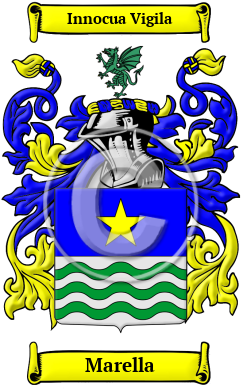
The motto was originally a war cry or slogan. Mottoes first began to be shown with arms in the 14th and 15th centuries, but were not in general use until the 17th century. Thus the oldest coats of arms generally do not include a motto. Mottoes seldom form part of the grant of arms: Under most heraldic authorities, a motto is an optional component of the coat of arms, and can be added to or changed at will; many families have chosen not to display a motto.
Motto: Innocua Vigila
Motto Translation: Watch the innocent
- Ellis Island Search retrieved 21st October 2021. Retrieved from https://heritage.statueofliberty.org/passenger-result
- National Records Search retrieved 21st October 2021. Retrieved from https://recordsearch.naa.gov.au
 |