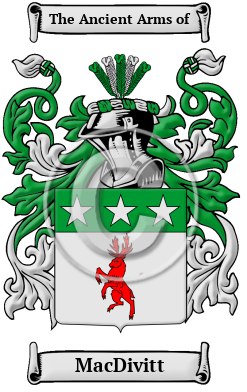
The Irish MacDivitt surname is derived from the Irish Gaelic Patronymic name "Mac Daibheid," which means son of David.
Loading...
Early Origins of the MacDivitt family
The surname MacDivitt was first found in on the Inishowen peninsula, in County Donegal, where a sept of this name claim David O'Doherty (d. 1208,) a chief of Cenel Eoghain, as their ancestor.
Early History of the MacDivitt family
This web page shows only a small excerpt of our MacDivitt research. Another 128 words (9 lines of text) are included under the topic Early MacDivitt History in all our PDF Extended History products and printed products wherever possible.
MacDivitt Spelling Variations
Names from the Middle Ages demonstrate many spelling variations. This is because the recording scribe or church official often decided as to how a person's name was spelt and in what language. Research into the name MacDivitt revealed many variations, including MacDaid, MacDavid, McDavid, Dade, MacDade, Devitt, MacDevitt, MacDavitt and many more.
Early Notables of the MacDivitt family
More information is included under the topic Early MacDivitt Notables in all our PDF Extended History products and printed products wherever possible.
Loading...
Loading...
Loading...
Loading...
Migration of the MacDivitt family
Thousands of Irish families left for North American shores in the 19th century. These people were searching for a life unencumbered with poverty, hunger, and racial discrimination. Many arrived to eventually find such conditions, but many others simply did not arrive: victims of the diseased, overcrowded ships in which they traveled to the New World. Those who lived to see North American shores were instrumental in the development of the growing nations of Canada and the United States. A thorough examination of passenger and immigration lists has disclosed evidence of many early immigrants of the name MacDivitt: William McDevit, who settled in Pennsylvania in 1771; James Devett, who came to Philadelphia, Pennsylvania in 1773; Philip McDevit, who settled in Pennsylvania in 1804.