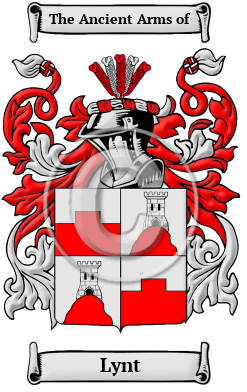
| ![Show Contents]() Lynt History, Family Crest & Coats of Arms Lynt History, Family Crest & Coats of Arms
Etymology of LyntWhat does the name Lynt mean? The Lynt surname comes from an Upper German word "lind," which meant "tender" or "gentle hearted." In some instances, especially in Saxony, the surname evolved from the personal name Lindemuth. In general, the similar phonetic name Linde comes from "Linden," which was a type of tree. Early Origins of the Lynt familyThe surname Lynt was first found in Hessen, where this family name became a prominent contributor to the development of the district from ancient times. Always prominent in social affairs, the name became an integral part of that turbulent region as it emerged to form alliances with other families within the Feudal System and the nation. Chronicles first mention Hainrich der Lind in Constance in 1254. Early History of the Lynt familyThis web page shows only a small excerpt of our Lynt research. Another 113 words (8 lines of text) covering the years 1780, 1784, 1799, 1820, 1834, 1862 and 1887 are included under the topic Early Lynt History in all our PDF Extended History products and printed products wherever possible. Lynt Spelling VariationsSpelling variations of this family name include: Lynd, Lindt, Lindemuth, Lint, Lyndt, Lind and others. Early Notables of the Lynt familyAnton Franz Hermann Lindt, a general in the Saxon army, who was ennobled in 1780. He was born in Frankfurt but moved with the family to Dresden. In 1784 he became general-inspector of the infantry, and in 1799 General of the infantry. His son, Carl Adolph Valentin von Lindt, became a major...
Another 51 words (4 lines of text) are included under the topic Early Lynt Notables in all our PDF Extended History products and printed products wherever possible.
| Lynt migration to West Indies | + |
The British first settled the British West Indies around 1604. They made many attempts but failed in some to establish settlements on the Islands including Saint Lucia and Grenada. By 1627 they had managed to establish settlements on St. Kitts (St. Christopher) and Barbados, but by 1641 the Spanish had moved in and destroyed some of these including those at Providence Island. The British continued to expand the settlements including setting the First Federation in the British West Indies by 1674; some of the islands include Barbados, Bermuda, Cayman Island, Turks and Caicos, Jamaica and Belize then known as British Honduras. By the 1960's many of the islands became independent after the West Indies Federation which existed from 1958 to 1962 failed due to internal political conflicts. After this a number of Eastern Caribbean islands formed a free association. 1Lynt Settlers in West Indies in the 17th Century- Robert Lynt, aged 21, who arrived in St Christopher in 1635 2
- Mr. Robert Lynt, (b. 1614), aged 21, British settler traveling aboard the ship "William and John" arriving in St Christopher (Saint Kitts) in 1635 3
- https://en.wikipedia.org/wiki/British_West_Indies
- Filby, P. William, Meyer, Mary K., Passenger and immigration lists index : a guide to published arrival records of about 500,000 passengers who came to the United States and Canada in the seventeenth, eighteenth, and nineteenth centuries. 1982-1985 Cumulated Supplements in Four Volumes Detroit, Mich. : Gale Research Co., 1985, Print (ISBN 0-8103-1795-8)
- Pilgrim Ship's of 1600's (Retrieved October 4th 2021 from https://www.packrat-pro.com/ships/shiplist.htm
 |