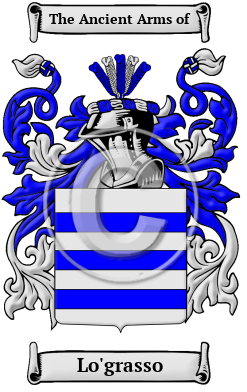
| ![Show Contents]() Lo'grasso History, Family Crest & Coats of Arms Lo'grasso History, Family Crest & Coats of Arms
Etymology of Lo'grassoWhat does the name Lo'grasso mean? From the historical and fascinating Italian region of Venice emerged a multitude of noble families, including the distinguished Lo'grasso family. Although people were originally known only by a single name, it became necessary for people to adapt a second name to identify themselves as populations grew and travel became more frequent. The process of adopting fixed hereditary surnames was not complete until the modern era, but the use of hereditary family names in Italy began in the 10th and 11th centuries. Italian hereditary surnames were developed according to fairly general principles and they are characterized by a profusion of derivatives coined from given names. Although the most common type of family name found in the region of Venice is the patronymic surname, which is derived from the father's given name, the nickname type of surname is also frequently found. Nickname surnames were derived from an eke-name, or added name. They usually reflected the physical characteristics or attributes of the first person that used the name. The surname Lo'grasso came from a person who was corpulent or stout. The surname Grassi is derived from the word grasso, which means overweight. Early Origins of the Lo'grasso familyThe surname Lo'grasso was first found in the city of Milan, in the region of Lombardy Early History of the Lo'grasso familyThis web page shows only a small excerpt of our Lo'grasso research. The years 1418, 1459, 1481, 1520, 1570, 1571, 1773 and 1800 are included under the topic Early Lo'grasso History in all our PDF Extended History products and printed products wherever possible. Lo'grasso Spelling VariationsIn comparison with other European surnames, Italian surnames have a surprising number of forms. They reflect the regional variations and the many dialects of the Italian language, each with its own distinctive features. For example, in Northern Italy the typical Italian surname suffix is "i", whereas in Southern Italy it is "o". Additionally, spelling changes frequently occurred because medieval scribes and church officials often spelled names as they sounded rather than according to any specific spelling rules. The spelling variations in the name Lo'grasso include Grassi, Grasso, De Grassi, Degrassi, Lo Grasso, La Grassa, Grasselli, Grassellini, Grassaleoni, Grassilli, Grassigli, Grassetti, Grassini, Grassani and many more. Early Notables of the Lo'grasso familyGiovannino De Grassi, an architect, sculptor, and miniaturist from Lombardy who helped to engineer the Milan Cathedral in the early 15th century. Nascimbene Grassaleoni of Ferrara became mayor of Sassuolo in 1418; Uguccione Grassaleoni was a lawyer and then Judge of the Commune of Ferrara in 1459. Carlo Grassi (1520-1571) was an Italian Roman Catholic bishop and cardinal. Giacomo di Grassi was an Italian fencing master who wrote the fencing treatise Ragione di adoprar sicuramente l'Arme, si da offesa come da difesa in 1570.
Ildebrando Grassi of Bologna...
Another 86 words (6 lines of text) are included under the topic Early Lo'grasso Notables in all our PDF Extended History products and printed products wherever possible. Migration of the Lo'grasso familyEarly immigration records have shown some of the first Lo'grassos to arrive on North American shores: John Grassi, who arrived in Baltimore, Maryland, in 1810 at the age of 35; Agostino Grasselli, aged 39, who arrived at Ellis Island from Saimano, Italy, in 1912.
| Contemporary Notables of the name Lo'grasso (post 1700) | + |
- Vito Joseph LoGrasso (b. 1964), American professional wrestler, best known for his work in World Championship Wrestling as Big Vito
 |