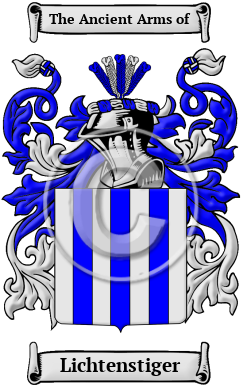
The Lichtenstiger surname is thought to be habitational in origin, deriving from the place name Lichtenstein. The place name stems from the German words "licht," meaning "light" and "stein" meaning "stone."
Loading...
Early Origins of the Lichtenstiger family
The surname Lichtenstiger was first found in Franconia, where this family name became a prominent contributor to the development of the district from ancient times. Always prominent in social affairs, the name became an integral part of that turbulent region as they emerged to form alliances with other families within the feudal system.
Early History of the Lichtenstiger family
This web page shows only a small excerpt of our Lichtenstiger research. Another 237 words (17 lines of text) covering the years 1304, 1402, 1466, 1777, 1889 and 1914 are included under the topic Early Lichtenstiger History in all our PDF Extended History products and printed products wherever possible.
Lichtenstiger Spelling Variations
Many cultural groups lived in the German states in medieval times. Each had its own dialect and traditions, and unique variations of popular names. Low German, which is similar to contemporary Dutch, was spoken in Westphalia. German names are characterized by additions such as regional suffixes and phrases that tell something about the origin or background of its original bearer. Further contributing to the variation in German names was the fact that there were no spelling rules in medieval times: scribes recorded names according to their sound. The recorded spelling variations of Lichtenstiger include Lichtenstein, Liechtenstein, Lichtensteen, Lichtenstine, Licktenstine, Lichenstine, Lichenstein, Lichenstien, Lichtstein, Lichtstien and many more.
Early Notables of the Lichtenstiger family
Another 33 words (2 lines of text) are included under the topic Early Lichtenstiger Notables in all our PDF Extended History products and printed products wherever possible.
Loading...
Loading...
Loading...
Loading...
Migration of the Lichtenstiger family
European migration to North America began in the mid-17th century and continued unabated until the mid-20th. Many Bavarians made the long trip to escape poverty or persecution based on their religious beliefs. The chance for tenant farmers to own their own land was also a major drawing card. They settled all across the United States in Pennsylvania, Texas, New York, Illinois, and California. Many came to Canada also, settling in Ontario and the prairie provinces. Analysis of immigration records has shown some of the first Lichtenstigers to arrive in North America, and among them were: Jacob Lichtenstein, who came to Philadelphia in 1846 and Joseph Lichtenstein, who came to Philadelphia in 1872.