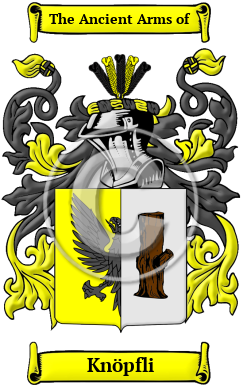
| ![Show Contents]() Knöpfli History, Family Crest & Coats of Arms Knöpfli History, Family Crest & Coats of Arms
- Origins Available:
Germany
Etymology of KnöpfliWhat does the name Knöpfli mean? The history of the Knöpfli family dates back to the 12th century, when hereditary surnames first began to be used in Germany. The name Knöpfli comes from Bavaria, and is derived from the Old German word "Knopf," meaning "button"; thus, it is a name for a maker of buttons, usually of horn. Early Origins of the Knöpfli familyThe surname Knöpfli was first found in Bavaria, where this family made important contributions toward the development of this district from ancient times. Ancient chronicles first mention the knight Johann Knop of Thuringia in 1368, Michel Knoepfle of Ravensburg in 1476, and Knoepfelman of Speyer in 1334. Early History of the Knöpfli familyThis web page shows only a small excerpt of our Knöpfli research. Another 112 words (8 lines of text) covering the years 1480, 1728, 1769, 1842, 1874, 1895 and 1920 are included under the topic Early Knöpfli History in all our PDF Extended History products and printed products wherever possible. Knöpfli Spelling VariationsIn the medieval era, many different cultural groups lived in the German states. There are thus many regional variations of German surnames from that era. Westphalians spoke Low German, which is similar to modern Dutch. Many German names carry suffixes that identify where they came from. Others have phrases attached that identify something about the original bearer. Other variations in German names resulted from the fact that medieval scribes worked without the aid of any spelling rules. The spelling variations of the name Knöpfli include Knopfler, Knopf, Knopfle, Knoepfel, Knoepfle, Knoepfli, Knoepfler, Knoff, Knof, Knofler, Knoffler, Knopfer, Knop, Knopler, Knauff, Knauffer, Knauffel and many more. Early Notables of the Knöpfli familyAnother 38 words (3 lines of text) are included under the topic Early Knöpfli Notables in all our PDF Extended History products and printed products wherever possible.
| Knöpfli migration to New Zealand | + |
Emigration to New Zealand followed in the footsteps of the European explorers, such as Captain Cook (1769-70): first came sealers, whalers, missionaries, and traders. By 1838, the British New Zealand Company had begun buying land from the Maori tribes, and selling it to settlers, and, after the Treaty of Waitangi in 1840, many British families set out on the arduous six month journey from Britain to Aotearoa to start a new life. Early immigrants include: Knöpfli Settlers in New Zealand in the 19th Century- Jacob Knopfli, aged 28, a farm labourer, who arrived in Wellington, New Zealand aboard the ship "Terpsichore" in 1876
 |