| ![Show Contents]() Jagel History, Family Crest & Coats of Arms Jagel History, Family Crest & Coats of Arms
- Origins Available:
Germany
Early Origins of the Jagel familyThe surname Jagel was first found in Prussia, where the name emerged in medieval times as one of the notable families of the region. From the 13th century the surname was identified with the great social and economic evolution which made this territory a landmark contributor to the development of the nation. Early History of the Jagel familyThis web page shows only a small excerpt of our Jagel research. Another 96 words (7 lines of text) covering the years 1553, 1623, 1838, 1861 and 1862 are included under the topic Early Jagel History in all our PDF Extended History products and printed products wherever possible. Jagel Spelling VariationsSpelling variations of this family name include: Yagel, Jäckel, Jackel, Jäckl, Jäckle, Yagle, Yagl, Yegle, Yegl, Yaegl, Yaegel, Jeckl, Jeckle, Jeckel, Jagl, Jagle, Jagel, Jegel, Jegl, Jegle, Jaeckel, Jaeckl, Jaeckl, Jaegle, Jaegl and many more. Early Notables of the Jagel familyMore information is included under the topic Early Jagel Notables in all our PDF Extended History products and printed products wherever possible.
| Jagel migration to the United States | + |
Jagel Settlers in United States in the 18th Century- Bernhart Jagel, who arrived in Pennsylvania in 1751
Jagel Settlers in United States in the 19th Century- Marks Jagel, aged 28, who landed in America, in 1892
Jagel Settlers in United States in the 20th Century- Marie Jagel, who settled in America, in 1906
- Hermann Jagel, aged 17, who landed in America from Bremen, Germany, in 1914
- Ernst Jagel, aged 32, who immigrated to the United States from Bremen, Germany, in 1922
- Bertha Jagel, aged 32, who landed in America from Bremen, Germany, in 1923
| Contemporary Notables of the name Jagel (post 1700) | + |
- Frederick Jagel (1897-1982), American tenor active at the Metropolitan Opera in the 1930s and 1940s
The motto was originally a war cry or slogan. Mottoes first began to be shown with arms in the 14th and 15th centuries, but were not in general use until the 17th century. Thus the oldest coats of arms generally do not include a motto. Mottoes seldom form part of the grant of arms: Under most heraldic authorities, a motto is an optional component of the coat of arms, and can be added to or changed at will; many families have chosen not to display a motto.
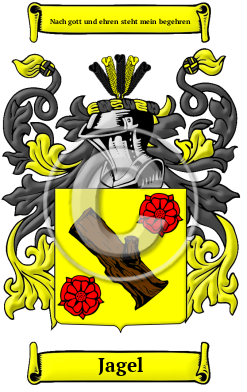
Motto: Nach gott und ehren steht mein begehren
Motto Translation: After God and desire stands my desire.
 |