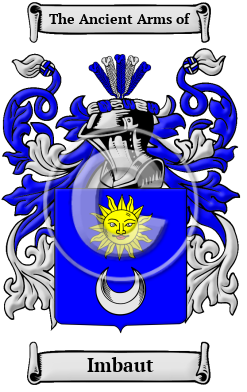
| ![Show Contents]() Imbaut History, Family Crest & Coats of Arms Imbaut History, Family Crest & Coats of Arms
- Origins Available:
France
Etymology of ImbautWhat does the name Imbaut mean? The region of ancient France known as Auvergne is where the name Imbaut was born. Imbaut was a name for someone who lived in Auvergne, where the family was found since the early Middle Ages. Early Origins of the Imbaut familyThe surname Imbaut was first found in Auvergne, a historic province in south central France. Early History of the Imbaut familyThis web page shows only a small excerpt of our Imbaut research. Another 23 words (2 lines of text) covering the years 1522, 1654, 1725, 1744, 1747 and 1810 are included under the topic Early Imbaut History in all our PDF Extended History products and printed products wherever possible. Imbaut Spelling VariationsFrench surnames were subject to numerous spelling alterations depending on the region and time it was used. The early development of the French language relied heavily on borrowing elements and grammar from other languages. For example, Old French was infused with Germanic words and sounds when barbarian tribes invaded and settled in France after the fall of the Roman Empire. Middle French also borrowed heavily from the Italian language during the Renaissance. As a result of these linguistic and cultural influences, the name Imbaut is distinguished by a number of regional variations. The many spelling variations of the name include Imbault, Imbeault, Imbaud, Imbert, Imbard, Imbart, Imberton, Imbelot, Imberdis, Imbeau and many more. Early Notables of the Imbaut familyJoseph-Gabriel Imbert, born in Marseille in 1654, who was a painter. His master was a talented but little known artist named Serre. He moved to Paris and perfected his art, inspired by the likes of Charles le Brun and van der Meulen. Colomès-Jacques Imbert was a politician born in Lyon in 1725. He came from a wealthy family of merchants, and was known for his talents in the sciences...
Another 69 words (5 lines of text) are included under the topic Early Imbaut Notables in all our PDF Extended History products and printed products wherever possible.
| Imbaut migration to Canada | + |
France was active as a cultural leader in the early 16th century. One particular area in which they lead was the exploration of the New World. The explorers, like Jacques Cartier in 1534, led the way to North America. Champlain, in 1608, made the first of twenty voyages to France to attract settlers and brought the first migrant in 1617. By 1675, there were 7000 French in Quebec, and the French Acadian presence in the Maritimes had reached 500. The French founded Lower Canada, thus becoming one of the two great founding nations of Canada. The family name Imbaut has made many distinguished contributions in France and New France to the world of science, culture, religion, and education. Amongst the settlers in North America with this distinguished name Imbaut were Imbaut Settlers in Canada in the 17th Century- Guillaume Imbaut married in Montreal in 1698
- Guillaume Imbaut married Marie-Madeleine Cherlot, daughter of Jean and Jeanne, in Montreal, Quebec on 10th November 1698 1
Imbaut Settlers in Canada in the 18th Century- Simon Imbaut, son of Guillaume and Louise-Marie, who married Marie-Jeanne Durand, daughter of Pierre and Thérèse, in Montreal, Quebec on 31st January 1735 1
- Claude Imbaut married in Montreal in 1736
- Guillaume Imbaut, son of Guillaume and Louise-Marie, who married Marguerite Gastion, daughter of Antoine and Madeleine, in Montreal, Quebec on 16th July 1736 1
- Paul Imbaut, son of Guillaume and Marie-Madeleine, who married Charlotte Cavelier, daughter of Jean-Baptiste and Jeanne, in Longue-Pointe, Quebec on 12th August 1737 1
- Pierre Imbaut, son of Guillaume and Louise-Marie, who married Marie-Antoinette Péladeau, daughter of Jean and Catherine, in Montreal, Quebec on 14th February 1752 1
- ... (More are available in all our PDF Extended History products and printed products wherever possible.)
- Internoscia, Arthur E., and Claire Chevrier. Dictionnaire National des Canadiens Français 1608-1760. Vol. 1, Institut Drouin, 1958.
 |