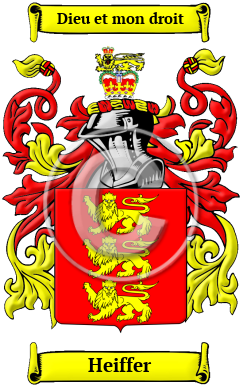
The surname Heiffer was first found in Somerset, where the name first appears in written records in the 14th century. The name Heiffer, like many surnames, is an occupational surname, coming from whatever job the first bearer did for a living. In this case, the name is metonymic, coming from an object associated with the job, rather than the name of the job itself; the first bearer of the name was a farmer who herded cattle. A young cow is called a heifer, and it is from this that the name arises.
Early History of the Heiffer family
This web page shows only a small excerpt of our Heiffer research. Another 51 words (4 lines of text) covering the year 1327 is included under the topic Early Heiffer History in all our PDF Extended History products and printed products wherever possible.
Heiffer Spelling Variations
Anglo-Norman names tend to be marked by an enormous number of spelling variations. This is largely due to the fact that Old and Middle English lacked any spelling rules when Norman French was introduced in the 11th century. The languages of the English courts at that time were French and Latin. These various languages mixed quite freely in the evolving social milieu. The final element of this mix is that medieval scribes spelled words according to their sounds rather than any definite rules, so a name was often spelled in as many different ways as the number of documents it appeared in. The name was spelled Heffer, Heiffer, Heffner, Hayfour, Heifers and many more.
Early Notables of the Heiffer family
More information is included under the topic Early Heiffer Notables in all our PDF Extended History products and printed products wherever possible.
Loading...
Loading...
Loading...
Loading...
Migration of the Heiffer family
Because of the political and religious discontent in England, families began to migrate abroad in enormous numbers. Faced with persecution and starvation at home, the open frontiers and generally less oppressive social environment of the New World seemed tantalizing indeed to many English people. The trip was difficult, and not all made it unscathed, but many of those who did get to Canada and the United States made important contributions to the young nations in which they settled. Some of the first North American settlers with Heiffer name or one of its variants: John Heifer, who came to Virginia in 1654; as well as Feridrick Heffer, who came to Pennsylvania in 1732.
The motto was originally a war cry or slogan. Mottoes first began to be shown with arms in the 14th and 15th centuries, but were not in general use until the 17th century. Thus the oldest coats of arms generally do not include a motto. Mottoes seldom form part of the grant of arms: Under most heraldic authorities, a motto is an optional component of the coat of arms, and can be added to or changed at will; many families have chosen not to display a motto.
Motto: Dieu et mon droit Motto Translation: God, and my right.
Remove Item
WARNING!
Removing this item from your shopping cart will remove your associated sale items.
Are you sure you want to delete this item from your shopping cart?
HouseofNames E-Newsletter Sign Up
Lucky names, rich traditions - celebrate this March 17th!
Your surname's story, touched by St. Patrick's luck