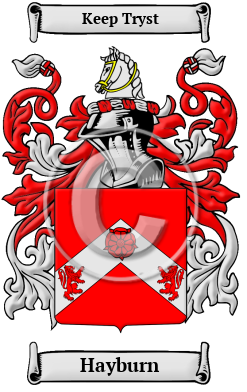
| ![Show Contents]() Hayburn History, Family Crest & Coats of Arms Hayburn History, Family Crest & Coats of Arms
Etymology of HayburnWhat does the name Hayburn mean? In the annals of British history, few names go farther back than Hayburn, which started among the people of the Boernician tribe. The first family to use the name Hayburn lived in Northumberland, in the village of Hebburn in the parish of Chillingham. Early Origins and Etymology of HayburnThe surname Hayburn was first found in Northumberland at Hebburn, a township, in the parish of Chillingham, union of Glendale. "There are some remains of an ancient castle, built, and long occupied, by a family which took its name from the village." 1 Now part of the Tyne and Wear county, Hebburn dates back to about 1104-08 when it was first listed as Heabyrn. Literally the place name means "high burial place or tumulus," from the Old English words "heah" + "byrgen." 2 One of the first records of the name was Thomas de Heburn who was listed in the Assize Rolls of Northumberland in 1279. 3 Early History of the Hayburn familyThis web page shows only a small excerpt of our Hayburn research. Another 137 words (10 lines of text) covering the years 1279, 1329, 1550, 1563, 1612 and 1660 are included under the topic Early Hayburn History in all our PDF Extended History products and printed products wherever possible. Hayburn Spelling VariationsThe name Hayburn, appeared in many references, and from time to time, the surname was spelt Hepburn, Heyburn, Hepborne, Hepbourne, Hepbourn and others. Early Notables of the Hayburn familyMore information is included under the topic Early Hayburn Notables in all our PDF Extended History products and printed products wherever possible. Migration of the Hayburn family to IrelandSome of the Hayburn family moved to Ireland, but this topic is not covered in this excerpt.
Another 36 words (3 lines of text) about their life in Ireland is included in all our PDF Extended History products and printed products wherever possible.
| Hayburn migration to the United States | + |
The New World beckoned as many of the settlers in Ireland, known as the Scotch/Irish, became disenchanted. They sailed aboard the armada of sailing ships known as the "White Sails" which plied the stormy Atlantic. Some called them, less romantically, the "coffin ships." Amongst the early settlers who could be considered kinsmen of the Hayburn family, or who bore a variation of the surname Hayburn were
Hayburn Settlers in United States in the 19th Century- Joseph Hayburn, who arrived in Washington County, Pennsylvania in 1828 4
The motto was originally a war cry or slogan. Mottoes first began to be shown with arms in the 14th and 15th centuries, but were not in general use until the 17th century. Thus the oldest coats of arms generally do not include a motto. Mottoes seldom form part of the grant of arms: Under most heraldic authorities, a motto is an optional component of the coat of arms, and can be added to or changed at will; many families have chosen not to display a motto.
Motto: Keep Tryst
- Lewis, Samuel, A Topographical Dictionary of England. Institute of Historical Research, 1848, Print.
- Mills, A.D., Dictionary of English Place-Names. Oxford: Oxford University Press, 1991. Print. (ISBN 0-19-869156-4)
- Reaney, P.H and R.M. Wilson, A Dictionary of English Surnames. London: Routledge, 1991. Print. (ISBN 0-415-05737-X)
- Filby, P. William, Meyer, Mary K., Passenger and immigration lists index : a guide to published arrival records of about 500,000 passengers who came to the United States and Canada in the seventeenth, eighteenth, and nineteenth centuries. 1982-1985 Cumulated Supplements in Four Volumes Detroit, Mich. : Gale Research Co., 1985, Print (ISBN 0-8103-1795-8)
 |