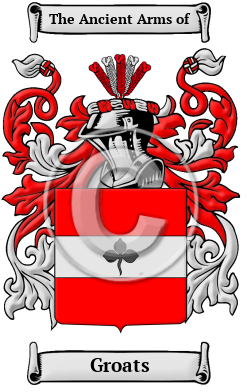
The German surname Groats emerged in the lands that formed the powerful German state of Prussia, which at one time was an immense German territory that stretched from France and the Low Countries to the Baltic sea and Poland. After the fall of the Roman Empire, the German territories were inhabited by a variety of Barbarian tribes. The borders of the Barbarian kingdoms changed frequently, but the region that became known as Prussia was roughly divided between the areas of Brandenburg-Prussia, West Prussia, and East Prussia. Brandenburg-Prussia was essentially the birthplace of modern Germany. By the 19th century, Brandenburg-Prussia had incorporated East Prussia, West Prussia and many other German territories. Moreover, in the late 19th century, it led the German states in the unification of Germany.
Loading...
Early Origins of the Groats family
The surname Groats was first found in Prussia, where this family became a prominent contributor to the development of the area from ancient times.
Early History of the Groats family
This web page shows only a small excerpt of our Groats research. Another 78 words (6 lines of text) covering the years 1775, 1800, 1843, 1883 and 1899 are included under the topic Early Groats History in all our PDF Extended History products and printed products wherever possible.
Groats Spelling Variations
Spelling variations of this family name include: Grothe, Groth, Grot, Groat, Groete, Groethe, Groet, Groter and many more.
Early Notables of the Groats family
Another 50 words (4 lines of text) are included under the topic Early Groats Notables in all our PDF Extended History products and printed products wherever possible.
Loading...
Loading...
Loading...
Loading...
Migration of the Groats family
Some of the first settlers of this family name or some of its variants were: Heinrich Grote, who sailed to America in 1780; Christian Grote sailed to Canada in 1783; Johan Jurgen Groth sailed to Pennsylvania in 1798; Friedericks Grote settled in Texas in 1846.