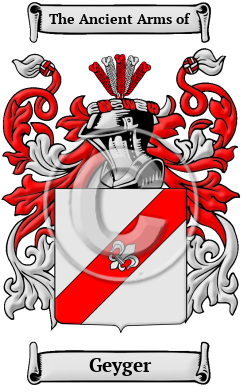
| ![Show Contents]() Geyger History, Family Crest & Coats of Arms Geyger History, Family Crest & Coats of Arms
- Origins Available:
Germany
Etymology of GeygerWhat does the name Geyger mean? The surname Geyger is a German occupational surname that evolved in the region known as the Rhineland. Germans at first used only one name, but population growth and increased travel in medieval times caused confusion between people of the same name, forcing the people to adopt hereditary surnames. These names often identified people by the kind of work they did. Geyger is a name for a musician or a person who played the violin. The name Geyger is derived from the Old German word "gigaere," which means "violinist" or "fiddle player." Early Origins of the Geyger familyThe surname Geyger was first found in the Rhine region, where the name contributed greatly to the development of an emerging nation which would later play a large role in the tribal and national conflicts of the area. In later years the name branched into many houses, each playing a significant role in the local social and political affairs. Early History of the Geyger familyThis web page shows only a small excerpt of our Geyger research. Another 134 words (10 lines of text) covering the years 1775 and 1789 are included under the topic Early Geyger History in all our PDF Extended History products and printed products wherever possible. Geyger Spelling VariationsIn the medieval era, many different cultural groups lived in the German states. There are thus many regional variations of German surnames from that era. Westphalians spoke Low German, which is similar to modern Dutch. Many German names carry suffixes that identify where they came from. Others have phrases attached that identify something about the original bearer. Other variations in German names resulted from the fact that medieval scribes worked without the aid of any spelling rules. The spelling variations of the name Geyger include Geiger, Geige, Geyger, Gieger, Geygher, Geigher and many more. Early Notables of the Geyger familyMore information is included under the topic Early Geyger Notables in all our PDF Extended History products and printed products wherever possible.
| Geyger migration to the United States | + |
The great European flow of migration to North America, which began in the middle of the 17th century and continued into the 20th century, was particularly attractive to those from the Rhineland who wished to escape either poverty or religious persecution. Many of those who left the Rhineland to seek their fortunes in the prosperous and free New World settled in the major urban centers of the United States and Canada. In the United States, the settlers from the Rhineland passed through immigration centers like that of Ellis Island, most of them moving on to Pennsylvania, Ohio, Texas, Illinois, California, and New York. In Canada, the majority of Rhinelanders settled in Ontario and the prairie provinces. An examination of passenger and immigration lists has revealed many important settlers to North America bearing the name Geyger, or one of its variants above:
Geyger Settlers in United States in the 18th Century- Michael Geyger, who landed in Pennsylvania in 1731 1
- Christian Geyger, who landed in Pennsylvania in 1737 1
- Valentine Geyger, who arrived in Pennsylvania in 1740 1
- Fred Geyger, aged 39, who landed in Pennsylvania in 1740 1
- Jacob Geyger, who arrived in Pennsylvania in 1744 1
- ... (More are available in all our PDF Extended History products and printed products wherever possible.)
Geyger Settlers in United States in the 19th Century- Joseph Geyger, aged 31, who arrived in Pennsylvania in 1805 1
- Anna Geyger, aged 30, who arrived in Pennsylvania in 1805 1
- Elizabeth Geyger, aged 34, who arrived in Pennsylvania in 1805 1
- Filby, P. William, Meyer, Mary K., Passenger and immigration lists index : a guide to published arrival records of about 500,000 passengers who came to the United States and Canada in the seventeenth, eighteenth, and nineteenth centuries. 1982-1985 Cumulated Supplements in Four Volumes Detroit, Mich. : Gale Research Co., 1985, Print (ISBN 0-8103-1795-8)
 |