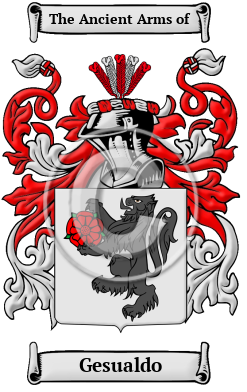
| ![Show Contents]() Gesualdo History, Family Crest & Coats of Arms Gesualdo History, Family Crest & Coats of Arms
Early Origins of the Gesualdo familyThe surname Gesualdo was first found in Naples, (Italian: Napoli, Latin: Neapolis) former capital of the Kingdom of the Two Sicilies in southern Italy; it is the chief city of the province of Naples. It shares with Instanbul the claim to be the most beautiuful city in Europe. Naples has 237 Churches and 57 Chapels. The National Museum and other galleries contain riches in art and artifacts. In those ancient times only persons of rank, the podesta, clergy, city officials, army officers, artists, landowners were entered into the records. To be recorded at this time, at the beginning of recorded history, was of itself a great distinction and indicative of noble ancestry. Early History of the Gesualdo familyThis web page shows only a small excerpt of our Gesualdo research. Another 179 words (13 lines of text) covering the years 1152, 1183, 1288, 1385, 1540, 1566, 1596, 1603 and 1613 are included under the topic Early Gesualdo History in all our PDF Extended History products and printed products wherever possible. Gesualdo Spelling VariationsSpelling variations of this family name include: Gesualdo, Gesualo, Gesualdio, Gesuladio, Gesulao and others. Early Notables of the Gesualdo family- the Gesualdo di Napoli, Duke Caggiano
- Carlo Gesualdo, also known as Gesualdo da Venosa (1566-1613), Prince of Venosa and Count of Conza, an Italian nobleman, lutenist and composer
- Alfonso Gesualdo (1540-1603), an Italian Cardinal
| Gesualdo migration to the United States | + |
Gesualdo Settlers in United States in the 19th Century- Costanzo Gesualdo, aged 47, who landed in America, in 1896
Gesualdo Settlers in United States in the 20th Century- Antonio Gesualdo, aged 25, who immigrated to the United States from Magisano, in 1901
- Antonio Gesualdo, aged 32, who landed in America from Sersale, Italy, in 1911
- Carmela Gesualdo, aged 19, who settled in America from Bonita, Italy, in 1912
- Amerino Gesualdo, aged 18, who landed in America from Magisano, Italy, in 1922
 |