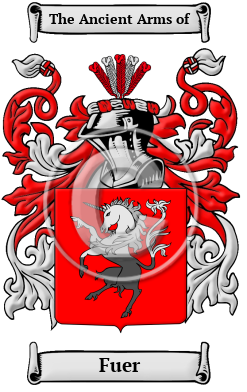
| ![Show Contents]() Fuer History, Family Crest & Coats of Arms Fuer History, Family Crest & Coats of Arms
- Origins Available:
Germany
Etymology of FuerWhat does the name Fuer mean? The name Fuer derives from the German word "feuer" meaning "fire," and was probably an occupational name for someone who worked with fire such as a smith, a fire lighter, or a person who took care of the heating a household. Early Origins of the Fuer familyThe surname Fuer was first found in Austria, where the family gained a significant reputation for its contributions to the emerging mediaeval society. The name became prominent as many branches of the family founded separate houses and acquired estates in various regions, always elevating their social status by their great contributions to society. Individual bearers of the name first mentioned in ancient chronicles include Pertholt der Feurer in the Sonnenberg monastery around 1350. Early History of the Fuer familyThis web page shows only a small excerpt of our Fuer research. Another 205 words (15 lines of text) covering the years 1297 and 1702 are included under the topic Early Fuer History in all our PDF Extended History products and printed products wherever possible. Fuer Spelling VariationsMany cultural groups lived in the German states in medieval times. Each had its own dialect and traditions, and unique variations of popular names. Low German, which is similar to contemporary Dutch, was spoken in Westphalia. German names are characterized by additions such as regional suffixes and phrases that tell something about the origin or background of its original bearer. Further contributing to the variation in German names was the fact that there were no spelling rules in medieval times: scribes recorded names according to their sound. The recorded spelling variations of Fuer include Feuer, Feuerer, Feirer, Feierle, Feuerre, Fuer, Fewer, Fuere and many more. Early Notables of the Fuer familyMore information is included under the topic Early Fuer Notables in all our PDF Extended History products and printed products wherever possible.
| Fuer migration to the United States | + |
After the First World War, Austria became a republic. The Treaty of Versailles broke up the empire in 1919 and many of the Sudeten Germans were incorporated into the new nation of Czechoslovakia. In the 20th century, many Austrians migrated to other parts of Germany or Europe, as well as to North America. In the United States, the majority of settlers landed in Philadelphia, and moved on to Ohio, Texas, Illinois, California, New York, and Maryland. Many German settlers also migrated to Canada, particularly Ontario and the Prairies. Amongst the settlers in North America with this distinguished name Fuer were
Fuer Settlers in United States in the 17th Century- Sam Fuer, who arrived in Virginia in 1652 1
Fuer Settlers in United States in the 19th Century- Emil Fuer, who settled in Texas in 1853
- Filby, P. William, Meyer, Mary K., Passenger and immigration lists index : a guide to published arrival records of about 500,000 passengers who came to the United States and Canada in the seventeenth, eighteenth, and nineteenth centuries. 1982-1985 Cumulated Supplements in Four Volumes Detroit, Mich. : Gale Research Co., 1985, Print (ISBN 0-8103-1795-8)
 |