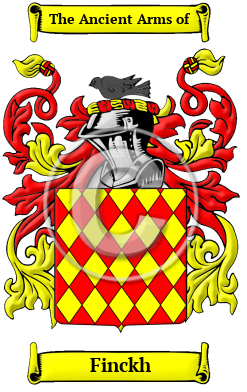
| ![Show Contents]() Finckh History, Family Crest & Coats of Arms Finckh History, Family Crest & Coats of Arms
- Origins Available:
Germany
Etymology of FinckhWhat does the name Finckh mean? From the historical and enchanting region of Austria emerged a multitude of noble families, including the distinguished Finckh family. Originally, the Austrian people were known only by a single name. The process by which hereditary surnames were adopted in Austria is extremely interesting. Surnames evolved during the Middle Ages when people began to assume an extra name to avoid confusion and to further identify themselves. Often they adopted names that were derived from nicknames. Nickname surnames were derived from an "eke-name," or added name. They usually reflected the physical characteristics or attributes of the first person that used the name. The name Finckh is a nickname type of surname for a cheerful person who sings songs. Further research revealed that the name is derived from the German word fink, which means finch, which is a type of small bird. Early Origins of the Finckh familyThe surname Finckh was first found in Austria, where the name was closely identified in early mediaeval times with the feudal society which would become prominent throughout European history. The name would later emerge as a noble family with great influence, having many distinguished branches, and become noted for its involvement in social, economic and political affairs. Early History of the Finckh familyThis web page shows only a small excerpt of our Finckh research. Another 115 words (8 lines of text) covering the years 1445, 1527, 1718, 1766, 1783, 1792, 1804, 1808, 1809, 1820, 1827, 1841, 1842 and 1846 are included under the topic Early Finckh History in all our PDF Extended History products and printed products wherever possible. Finckh Spelling VariationsMany cultural groups lived in the German states in medieval times. Each had its own dialect and traditions, and unique variations of popular names. Low German, which is similar to contemporary Dutch, was spoken in Westphalia. German names are characterized by additions such as regional suffixes and phrases that tell something about the origin or background of its original bearer. Further contributing to the variation in German names was the fact that there were no spelling rules in medieval times: scribes recorded names according to their sound. The recorded spelling variations of Finckh include Finck, Fincke, Finckl (Bavaria), Finncke, Fink, Finke, Finkl, Finke and many more. Early Notables of the Finckh familyHeinrich Finck (1445-1527), who was composer and court musician for both Polish and German princes. Friedrich August von Finck (1718-1766) was a Prussian soldier who served in the Danish and Russian forces.
Gottfried Wilhelm Fink (1783-1846), theologian and musical critic was born March 7, 1783, at Sulz in Thuringia and was educated at Naumburg, where he was chorister, and...
Another 59 words (4 lines of text) are included under the topic Early Finckh Notables in all our PDF Extended History products and printed products wherever possible. Migration of the Finckh familyAustria was made a republic after the First World War. The Austro-Hungarian Empire was broken up by the Treaty of Versailles and many of its people found themselves in the new nation of Czechoslovakia. Many other Austrians and expatriate Austrians made their way to North America in the 20th century. Most landed in Philadelphia, later continuing on to the states of Ohio, Texas, Illinois, California, New York, and Maryland. Some Austrian settlers also went to western Canada and Ontario. Research into the origins of individual families in North America revealed records of the immigration of a number of people bearing the name Finckh or a variant listed above: Frantz Finck, who came to New York State in 1710-11; Johann Nicholas Finck arrived in Philadelphia in 1737; as did Conrad Finck in 1741; and Daniel Finck in 1749. Adam Fink came to the same city in 1764.
| Contemporary Notables of the name Finckh (post 1700) | + |
- Beate Finckh (b. 1960), German actress
- Ludwig Finckh (1876-1964), friend of Hermann Hesse and a popular writer at the turn of the century
 |