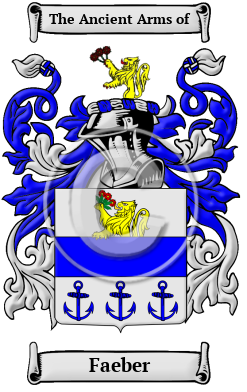
| ![Show Contents]() Faeber History, Family Crest & Coats of Arms Faeber History, Family Crest & Coats of Arms
Etymology of FaeberWhat does the name Faeber mean? Bavaria, Germany is the ancestral home of the Faeber family. The Germans began using hereditary surnames in the 12th century. Faeber is an occupational name, which was derived from the kind of work done by the original bearer. It is a name for a craftsman or artisan. The name Faeber is derived from the Latin word "faber," which means "ingenious" or "skillful" and refers to a master craftsman. Early Origins of the Faeber familyThe surname Faeber was first found in Bavaria, where the name emerged in mediaeval times as one of the notable families of the region. From the 13th century the surname was identified with the great social and economic evolution which made this territory a landmark contributor to the development of the nation. Early History of the Faeber familyThis web page shows only a small excerpt of our Faeber research. Another 161 words (12 lines of text) covering the years 1552, 1652, 1660, 1687, 1695, 1715, 1721, 1745, 1756, 1757 and 1760 are included under the topic Early Faeber History in all our PDF Extended History products and printed products wherever possible. Faeber Spelling VariationsIn the medieval era, many different cultural groups lived in the German states. There are thus many regional variations of German surnames from that era. Westphalians spoke Low German, which is similar to modern Dutch. Many German names carry suffixes that identify where they came from. Others have phrases attached that identify something about the original bearer. Other variations in German names resulted from the fact that medieval scribes worked without the aid of any spelling rules. The spelling variations of the name Faeber include Faber, Fabert, Fabers, Faeber, Fabricius (Latin) and others. Early Notables of the Faeber familyHeinrich Faber (d. 1552), who was an important theorist and music historian; Kaspar Faber of Nuremberg founded the Faber lead-pencil manufacturing dynasty in 1760.
John Faber the Elder (1660?-1721), was a draughtsman and mezzotint engraver, a native of the Hague, born about 1660, is usually stated to have settled in England about 1687, bringing with him his son, John Faber, then about three years of age.
John...
Another 65 words (5 lines of text) are included under the topic Early Faeber Notables in all our PDF Extended History products and printed products wherever possible. Migration of the Faeber familyBetween the mid-17th and mid-20th centuries, German settlers arrived in North America by the thousands. Persecution based on religion and poverty were great motivators in this large-scale migration. So too was the opportunity for tenant farmers to own their own land. Ample land and opportunity awaited the settlers who went to such states as Pennsylvania, Texas, New York, Illinois, and California, as well as Ontario and the prairie provinces of Canada. Research into the origins of individual families in North America revealed records of the immigration of a number of people bearing the name Faeber or a variant listed above: Hans Faber, who came to Lancaster, Pennsylvania in 1712; Frantz Nicolaus Faber came to Philadelphia in 1749; and Joseph Faber came to New England in 1635. Anton Faber, aged 32.
 |