| ![Show Contents]() Eler History, Family Crest & Coats of Arms Eler History, Family Crest & Coats of Arms
- Origins Available:
Germany
Etymology of ElerWhat does the name Eler mean? Nestled between the Rhine and Wesser rivers is the ancient German region of Westphalia. Westphalia, the home of the name Eler. When hereditary surnames were adopted in this region, after the 12th century, names that were derived from localities were quite common. These "local" surnames originally denoted the proprietorship of the village or estate. When coupled with the German preposition von, which means from or of, local names can indicate that the initial bearer of the name was an aristocrat. However, in modern times, the use of the preposition has often long since been dropped from use. The Eler family originally lived by an alder tree. Ancient records reveal the name Eler is derived from the Old German word elre or alre, which means alder. There are also numerous places named Eller in the northern German states, such as the Rhine and Moselle areas, which adopted the name of an old stream called the Ellera. Thus, the name Eler is both a topographic surname, a type of local surname that was given to a person who resided near a physical feature such as a hill, stream, church, or type of tree, and a habitation name, a type of local name that was originally derived from pre-existing names for towns, villages, parishes, or farmsteads. Early Origins of the Eler familyThe surname Eler was first found in Westphalia, where the family emerged in mediaeval times as one of the notable families of the region. From the 13th century the surname was identified with the great social and economic evolution which made this territory a landmark contributor to the development of the nation. Early History of the Eler familyThis web page shows only a small excerpt of our Eler research. Another 77 words (6 lines of text) covering the years 1354, 1424, 1680, 1690 and 1730 are included under the topic Early Eler History in all our PDF Extended History products and printed products wherever possible. Eler Spelling VariationsOne can encounter great variation in the spelling of surnames: in early times, spelling in general, and thus the spelling of names was not yet standardized; and later, spellings would change with branching and movement of families. Variations of the name Eler include Eller, Ellers, Eler, Aller, Aler, Ellern, Ellere, Elera, Ellera, Ellerer and many more. Early Notables of the Eler family- John Philip Ellers (fl. 1690-1730), German potter, the son of Martin Elers, and grandson of Admiral Elers, Commander of the Fleet at Hamburg, who was a member of a noble Saxon family. 1
| Eler migration to the United States | + |
Many Germans emigrated across the Atlantic to seek better lives in North America. This great migration began in the middle of the 17th century and continued into the 20th century. Resettlement was particularly attractive to those from Westphalia as a means of escape from poverty and religious persecution. For many Westphalian farmers, the chance to own one's own land was also a major incentive. The process of the widespread colonization of the United States began in 1650, when many immigrants from Germany settled in pockets in Pennsylvania, Texas, New York, Illinois, and California. In Canada, German settlements centered around Ontario and the Prairie provinces. Among them:
Eler Settlers in United States in the 18th Century- Geo Eler, aged 20, who landed in Pennsylvania in 1743 2
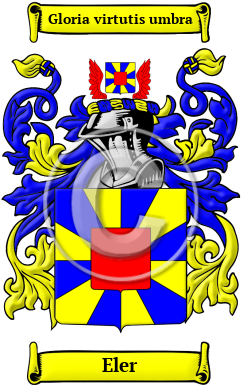
The motto was originally a war cry or slogan. Mottoes first began to be shown with arms in the 14th and 15th centuries, but were not in general use until the 17th century. Thus the oldest coats of arms generally do not include a motto. Mottoes seldom form part of the grant of arms: Under most heraldic authorities, a motto is an optional component of the coat of arms, and can be added to or changed at will; many families have chosen not to display a motto.
Motto: Gloria virtutis umbra
Motto Translation: Glory is the shadow of virtue.
- Smith, George (ed), Dictionary of National Biography. London: Smith, Elder & Co., 1885-1900. Print
- Filby, P. William, Meyer, Mary K., Passenger and immigration lists index : a guide to published arrival records of about 500,000 passengers who came to the United States and Canada in the seventeenth, eighteenth, and nineteenth centuries. 1982-1985 Cumulated Supplements in Four Volumes Detroit, Mich. : Gale Research Co., 1985, Print (ISBN 0-8103-1795-8)
 |