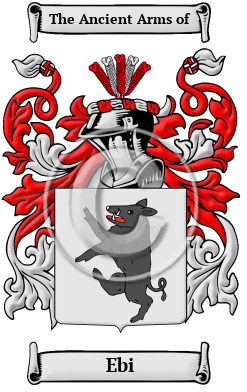
| ![Show Contents]() Ebi History, Family Crest & Coats of Arms Ebi History, Family Crest & Coats of Arms
- Origins Available:
Germany
Etymology of EbiWhat does the name Ebi mean? The distinguished surname Ebi is a proud sign of a rich and ancient Austrian ancestry. Austria, which was originally home to a Celtic people, was conquered by the Roman Empire in about 15 BC. Following the fall of Rome, Austria was repeatedly invaded by barbarian tribes, such as the Vandals, Visigoths, and Huns, who swept in from the east. During the 5th and 6th centuries, the Alemanni, Avars and Slavs settled Austria. The Avars were defeated in 785 by the Frankish emperor Charlemagne, who set up the East Mark, which later became known as the Österreich. Austria was ruled by the Babenburger dynasty until 1278, when they were succeeded by the Hapsburg dynasty, which ruled Austria until the 20th century. Early Origins of the Ebi familyThe surname Ebi was first found in Austria, where this family name became a prominent contributor to the development of the district from ancient times. Always prominent in social affairs, the name became an integral part of that turbulent region as it emerged to form alliances with other families within the Feudal System and the nation. The name was a popular short form for the name Eberhard in the Middle Ages. Early History of the Ebi familyThis web page shows only a small excerpt of our Ebi research. Another 178 words (13 lines of text) covering the years 1465, 1511, 1530, 1547, 1569, 1612, 1702, 1755, 1760, 1762, 1763, 1766, 1775, 1785, 1787, 1794, 1796, 1797, 1801, 1815, 1817, 1821, 1824 and 1826 are included under the topic Early Ebi History in all our PDF Extended History products and printed products wherever possible. Ebi Spelling VariationsOne can encounter great variation in the spelling of surnames: in early times, spelling in general, and thus the spelling of names was not yet standardized; and later, spellings would change with branching and movement of families. Variations of the name Ebi include Eberlein, Aberlin, Eberl, Eberlin, Eberling, Eber, Ebers, Eberr, Ebber, Eberle, Eberlen, Ebberl, Ebberle, Ebberlein, Ebberlin and many more. Early Notables of the Ebi familyPaul Eber (1511-1569), born in Franconia, who was a renowned professor of Latin. Johann von Guenzburg Eberlin (1465-1530), was Franciscan monk who converted to Protestantism. Johann Ernst Eberlin (1702-1762), a composer, was also court organist to the Prince-Archbishop of Salzburg and was an eminent German composer of sacred music. His original name was Eberle, which was turned, according to a custom then common with women, into Eberlin, and as such he retained it. He was the son of the land-steward to Baron von Stain, and was born March 27, 1702. He died at Salzburg, June 21, 1762. 1
John Ebers, born in...
Another 235 words (17 lines of text) are included under the topic Early Ebi Notables in all our PDF Extended History products and printed products wherever possible.
| Ebi migration to the United States | + |
After the First World War, Austria became a republic. The Treaty of Versailles broke up the empire in 1919 and many of the Sudeten Germans were incorporated into the new nation of Czechoslovakia. In the 20th century, many Austrians migrated to other parts of Germany or Europe, as well as to North America. In the United States, the majority of settlers landed in Philadelphia, and moved on to Ohio, Texas, Illinois, California, New York, and Maryland. Many German settlers also migrated to Canada, particularly Ontario and the Prairies. Amongst the settlers in North America with this distinguished name Ebi were
Ebi Settlers in United States in the 18th Century- Jacob Ebi, who landed in Pennsylvania in 1744 2
Ebi Settlers in United States in the 19th Century- D Ebi, who arrived in San Francisco, California in 1851 2
- Grove, Sir George, A Dictionary of Music and Musicians (AD. 1450-1889) London: Macmillan1902, Print, 2 Vols
- Filby, P. William, Meyer, Mary K., Passenger and immigration lists index : a guide to published arrival records of about 500,000 passengers who came to the United States and Canada in the seventeenth, eighteenth, and nineteenth centuries. 1982-1985 Cumulated Supplements in Four Volumes Detroit, Mich. : Gale Research Co., 1985, Print (ISBN 0-8103-1795-8)
 |