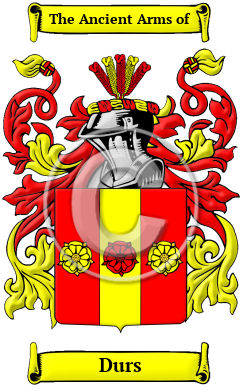
The German state of Bavaria is the ancestral home of the Durs family. Durs is a local name, first used as a surname for someone who lived on a dry, barren land. The name Durs is derived from the Old German word durri and the German word dürre, which mean barren or infertile.
Loading...
Early Origins of the Durs family
The surname Durs was first found in Franconia, where the name Duerer could be considered to make a great early contribution to the feudal society which became the backbone of early development of Europe. The name became prominent in local affairs and branched into many houses which played important roles in the tribal and national conflicts, each group seeking power and status in an ever changing territorial profile.
Early History of the Durs family
This web page shows only a small excerpt of our Durs research. Another 179 words (13 lines of text) covering the years 1172, 1471, 1528, 1690, 1784 and 1856 are included under the topic Early Durs History in all our PDF Extended History products and printed products wherever possible.
Durs Spelling Variations
In the medieval era, many different cultural groups lived in the German states. There are thus many regional variations of German surnames from that era. Westphalians spoke Low German, which is similar to modern Dutch. Many German names carry suffixes that identify where they came from. Others have phrases attached that identify something about the original bearer. Other variations in German names resulted from the fact that medieval scribes worked without the aid of any spelling rules. The spelling variations of the name Durs include Durr, Duerer, Duere, Duerr, Duer, Dur, Durre, Duerre, Dueren, Duerman and many more.
Early Notables of the Durs family
Another 47 words (3 lines of text) are included under the topic Early Durs Notables in all our PDF Extended History products and printed products wherever possible.
Loading...
Loading...
Loading...
Loading...
Migration of the Durs family
European migration to North America began in the mid-17th century and continued unabated until the mid-20th. Many Bavarians made the long trip to escape poverty or persecution based on their religious beliefs. The chance for tenant farmers to own their own land was also a major drawing card. They settled all across the United States in Pennsylvania, Texas, New York, Illinois, and California. Many came to Canada also, settling in Ontario and the prairie provinces. Analysis of immigration records has shown some of the first Durss to arrive in North America, and among them were: Alexander Durr, who settled in Philadelphia in 1840; Anderas Durr settled in Philadelphia in 1750; Johannes Balthasar Durr settled in Maryland in 1768.