
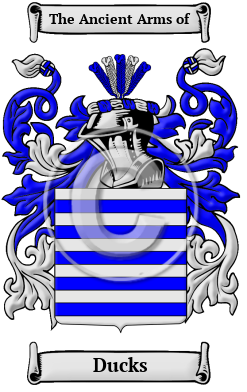
Show ContentsDucks History, Family Crest & Coats of Arms

Etymology of Ducks

What does the name Ducks mean?

The Ducks surname comes from the German term for a duck or diving bird (from du(c)ken ‘to dive or duck’). It is thought to have been a nickname for someone thought to resemble the duck, but in some instances may have been an occupational name for someone whose trade involved the handling of ducks.

Early Origins of the Ducks family

The surname Ducks was first found in Westphalia, where the name emerged in mediaeval times as one of the notable families in the western region. From the 13th century onwards the surname was identified with the great social and economic evolution which made this territory a landmark contributor to the development of the nation.

Early History of the Ducks family

This web page shows only a small excerpt of our Ducks research. Another 137 words (10 lines of text) covering the years 1671, 1687, 1720, 1819, 1833 and 1846 are included under the topic Early Ducks History in all our PDF Extended History products and printed products wherever possible.

Ducks Spelling Variations

In the medieval era, many different cultural groups lived in the German states. There are thus many regional variations of German surnames from that era. Westphalians spoke Low German, which is similar to modern Dutch. Many German names carry suffixes that identify where they came from. Others have phrases attached that identify something about the original bearer. Other variations in German names resulted from the fact that medieval scribes worked without the aid of any spelling rules. The spelling variations of the name Ducks include Ducker, Dücker, Ducher, Duckermann and many more.

Early Notables of the Ducks family

Another 31 words (2 lines of text) are included under the topic Early Ducks Notables in all our PDF Extended History products and printed products wherever possible.

Migration of the Ducks family

The great European flow of migration to North America, which began in the middle of the 17th century and continued into the 20th century, was particularly attractive to those from the Rhineland who wished to escape either poverty or religious persecution. Many of those who left the Rhineland to seek their fortunes in the prosperous and free New World settled in the major urban centers of the United States and Canada. In the United States, the settlers from the Rhineland passed through immigration centers like that of Ellis Island, most of them moving on to Pennsylvania, Ohio, Texas, Illinois, California, and New York. In Canada, the majority of Rhinelanders settled in Ontario and the prairie provinces. An examination of passenger and immigration lists has revealed many important settlers to North America bearing the name Ducks, or one of its variants above: Georg Ducker, who arrived in Georgia between the years 1733-1783; Joh Baltzer Ducker, who arrived in Philadelphia in 1753; Carl S. Ducker, who arrived at the port of Baltimore in 1832.


Houseofnames.com on Facebook
