| ![Show Contents]() Die History, Family Crest & Coats of Arms Die History, Family Crest & Coats of Arms
Etymology of DieWhat does the name Die mean? The River Dee flows through parts of both Wales and England, forming part of the border between the two countries. South east of Cumbria, a part of the Craven region traditionally part of the West Riding of Yorkshire is home to another River Dee and of course, there is another in Aberdeenshire, Scotland. Early Origins and Etymology of DieThe surname Die was first found in Cheshire where the name derives its name from the River Dee, which was first known as Deoua c. 150, an ancient Celtic river-name meaning "the goddess, the holy one." 1 Early History of the Die familyThis web page shows only a small excerpt of our Die research. Another 73 words (5 lines of text) covering the years 1527, 1579, 1608, 1634, 1638, 1651, 1657 and 1720 are included under the topic Early Die History in all our PDF Extended History products and printed products wherever possible. Die Spelling VariationsSpelling variations of this family name include: Dee, Die and others. Early Notables of the Die familyJohn Dee (1527- c.1608), Welsh noted mathematician, astronomer, astrologer, occultist, navigator, and consultant to Queen Elizabeth I; and Arthur Dee (1579-1651), his eldest son who became a noted physician and alchemist, physician to King Charles I. Duncan Dee (1657-1720), was an English pleader (an advocate in court), son of Rowland Dee...
Another 50 words (4 lines of text) are included under the topic Early Die Notables in all our PDF Extended History products and printed products wherever possible.
| Die migration to the United States | + |
Die Settlers in United States in the 19th Century- Cornelus Van Die, who arrived in Iowa in 1848 2
- Mrs. Cs Van Die, who landed in Iowa in 1848 2
Die Settlers in Canada in the 19th Century- David Die, aged 22, who arrived in Halifax, Nova Scotia in 1864
The motto was originally a war cry or slogan. Mottoes first began to be shown with arms in the 14th and 15th centuries, but were not in general use until the 17th century. Thus the oldest coats of arms generally do not include a motto. Mottoes seldom form part of the grant of arms: Under most heraldic authorities, a motto is an optional component of the coat of arms, and can be added to or changed at will; many families have chosen not to display a motto.
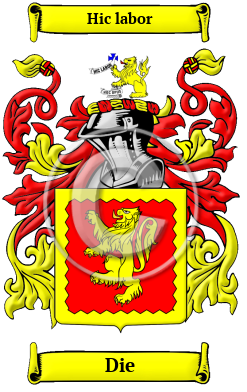
Motto: Hic labor
Motto Translation: This is the difficulty.
- Mills, A.D., Dictionary of English Place-Names. Oxford: Oxford University Press, 1991. Print. (ISBN 0-19-869156-4)
- Filby, P. William, Meyer, Mary K., Passenger and immigration lists index : a guide to published arrival records of about 500,000 passengers who came to the United States and Canada in the seventeenth, eighteenth, and nineteenth centuries. 1982-1985 Cumulated Supplements in Four Volumes Detroit, Mich. : Gale Research Co., 1985, Print (ISBN 0-8103-1795-8)
 |