
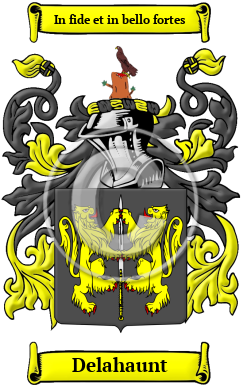
Show ContentsDelahaunt History, Family Crest & Coats of Arms

Etymology of Delahaunt

What does the name Delahaunt mean?

In its ancient Gaelic form, the Irish name Delahaunt was written Ó Dulchaointigh, which comes from the word dulchaointeach, which refers to a satirist. 1 The ancestor of this Irish family is said to have been Muintir Cormac or Muintir Dulchonta, which was gradually anglicized over the years, until it was rendered as Delahunt or Delahunty.

Although the name appears quite French, it seems highly unlikely that there are any French origins to the name, other than the Norman influence of the clerks, who began processing Irish names, as early as the 12th century.

Early Origins of the Delahaunt family

The surname Delahaunt was first found in Ormond, where records of the name can be found in deeds from around 1441 on. Petty's "census" of 1659 showed bearers of Delahaunt in counties Offaly (King's county) and Kilkenny. The ancient and important Delahaunt sept sometimes claims descent from the O'Hara Buidhe, Chiefs of Leyney in County Sligo, through Lughaidh.

Early History of the Delahaunt family

This web page shows only a small excerpt of our Delahaunt research. Another 69 words (5 lines of text) covering the years 1670 and 1735 are included under the topic Early Delahaunt History in all our PDF Extended History products and printed products wherever possible.

Delahaunt Spelling Variations

Irish names recorded during the Middle Ages are characterized by many spelling variations. This preponderance of variations for common names can be explained by the fact that the scribes and church officials that kept records during that period individually decided how to capture one's name. These recorders primarily based their decisions on how the name was pronounced or what it meant. Research into the name Delahaunt revealed many variations, including Delahunt, Delahunty, DeLahunte, DeLaHunty, De-la-Hunt, Delahunt and many more.

Early Notables of the Delahaunt family

More information is included under the topic Early Delahaunt Notables in all our PDF Extended History products and printed products wherever possible.

Migration of the Delahaunt family

Many Irish families boarded ships bound for North America in the middle of 19th century to escape the conditions of poverty and racial discrimination at that time. Although these immigrants often arrived in a destitute state, they went on to make important contributions to the emerging nations of the United States and Canada. An inquiry into many immigration and passenger lists has revealed many early immigrants to North America bearing the Delahaunt family name: Daniel Delahunty, who came to Maryland in 1749; Rose Delahunt, a bonded passenger who arrived in Maryland in 1755; as well as Lawrence Dulhunty, a Captain in the Royal Garrison Battalion, in 1779.


The Delahaunt Motto +

The motto was originally a war cry or slogan. Mottoes first began to be shown with arms in the 14th and 15th centuries, but were not in general use until the 17th century. Thus the oldest coats of arms generally do not include a motto. Mottoes seldom form part of the grant of arms: Under most heraldic authorities, a motto is an optional component of the coat of arms, and can be added to or changed at will; many families have chosen not to display a motto.

Motto: In fide et in bello fortes
Motto Translation: Firm in faith and war.


  1. MacLysaght, Edward, The Surnames of Ireland. Ireland: Irish Academic Press, sixth edition, 1985. Print. (ISBN 0-7165-2366-3)


Houseofnames.com on Facebook