| ![Show Contents]() De'villa History, Family Crest & Coats of Arms De'villa History, Family Crest & Coats of Arms
Etymology of De'villaWhat does the name De'villa mean? This surname is derived from the Latin word "villa," which originally meant a house or estate, but later came to denote a village. Thus, as a surname, De'villa no doubt was used to describe "someone from the village." Early Origins of the De'villa familyThe surname De'villa was first found in Castille where bearers of the name were found in the mountains of Santander. Early History of the De'villa familyThis web page shows only a small excerpt of our De'villa research. Another 54 words (4 lines of text) covering the years 1656, 1676, 1692, 1694 and 1757 are included under the topic Early De'villa History in all our PDF Extended History products and printed products wherever possible. De'villa Spelling VariationsSpelling variations of this family name include: Villa, Devilla, de Villa, Villas and others. Early Notables of the De'villa familyMore information is included under the topic Early De'villa Notables in all our PDF Extended History products and printed products wherever possible.
| De'villa migration to the United States | + |
De'villa Settlers in United States in the 16th Century- Rodrigo DeVilla, who arrived in Argentina in 1539
De'villa Settlers in United States in the 19th Century- Pedro DeVilla, who landed in Rio de la Plata in 1835 1
- Julius Devilla, who was naturalized in Ohio in 1862
| Contemporary Notables of the name De'villa (post 1700) | + |
- Tita de Villa (1931-2014), stage name of Teresa Theodossis-Martin, Filipina actress from the Philippines who made over 70 film appearences
- Alfredo De Villa, Mexican director, best known for directing award winning films including Adrift in Manhattan (2007)
- José de Villa (1924-1950), Filipino film actor in the 1950s and a film director in the late 1950s and 1960s
- Néstor de Villa (1928-2004), stage name of Gines Francisco Soriano, Filipino actor and gifted dancer, some called him the "Fred Astaire of the Philippines"
- Renato "Rene" de Villa (b. 1935), Philippine former politician, Secretary of National Defense (1991-1997), Chief of Staff of the Armed Forces of the Philippines (1988-1991)
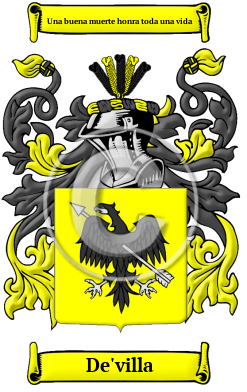
The motto was originally a war cry or slogan. Mottoes first began to be shown with arms in the 14th and 15th centuries, but were not in general use until the 17th century. Thus the oldest coats of arms generally do not include a motto. Mottoes seldom form part of the grant of arms: Under most heraldic authorities, a motto is an optional component of the coat of arms, and can be added to or changed at will; many families have chosen not to display a motto.
Motto: Una buena muerte honra toda una vida
Motto Translation: A good death honors the whole life.
- Filby, P. William, Meyer, Mary K., Passenger and immigration lists index : a guide to published arrival records of about 500,000 passengers who came to the United States and Canada in the seventeenth, eighteenth, and nineteenth centuries. 1982-1985 Cumulated Supplements in Four Volumes Detroit, Mich. : Gale Research Co., 1985, Print (ISBN 0-8103-1795-8)
 |