


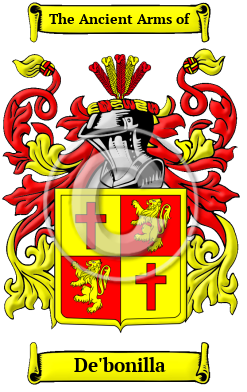
Show ContentsDe'bonilla History, Family Crest & Coats of Arms

Etymology of De'bonilla

What does the name De'bonilla mean?

Noble surnames, such as De'bonilla, evoke images of the ancient homeland of the Spanish people. The original bearer of the name De'bonilla, which is a local surname, once lived, held land, or was born in the beautiful region of Spain. Many Spanish local names reflect Arabic words or place-names because the Muslim Moors from the 8th to 12th centuries conquered Spain. The De'bonilla family originally lived in the place named Bonilla, which is in the province of Cuenca, Spain. Often the surname De'bonilla is preceded by the prefix de, which means of or from and indicates that the name is local in origin.

Early Origins of the De'bonilla family

The surname De'bonilla was first found in Castile, an important Christian kingdom of medieval Spain.

Early History of the De'bonilla family

This web page shows only a small excerpt of our De'bonilla research. Another 99 words (7 lines of text) are included under the topic Early De'bonilla History in all our PDF Extended History products and printed products wherever possible.

De'bonilla Spelling Variations

Spelling variations of this family name include: Bonilla, de Bonilla, Bonella, Bonel, Bonillo and others.

Early Notables of the De'bonilla family

More information is included under the topic Early De'bonilla Notables in all our PDF Extended History products and printed products wherever possible.


De'bonilla migration to West Indies +

The British first settled the British West Indies around 1604. They made many attempts but failed in some to establish settlements on the Islands including Saint Lucia and Grenada. By 1627 they had managed to establish settlements on St. Kitts (St. Christopher) and Barbados, but by 1641 the Spanish had moved in and destroyed some of these including those at Providence Island. The British continued to expand the settlements including setting the First Federation in the British West Indies by 1674; some of the islands include Barbados, Bermuda, Cayman Island, Turks and Caicos, Jamaica and Belize then known as British Honduras. By the 1960's many of the islands became independent after the West Indies Federation which existed from 1958 to 1962 failed due to internal political conflicts. After this a number of Eastern Caribbean islands formed a free association. 1
De'bonilla Settlers in West Indies in the 19th Century
  • Pedro DeBonilla, who arrived in Dominican Republic in 1836 2


  1. https://en.wikipedia.org/wiki/British_West_Indies
  2. Filby, P. William, Meyer, Mary K., Passenger and immigration lists index : a guide to published arrival records of about 500,000 passengers who came to the United States and Canada in the seventeenth, eighteenth, and nineteenth centuries. 1982-1985 Cumulated Supplements in Four Volumes Detroit, Mich. : Gale Research Co., 1985, Print (ISBN 0-8103-1795-8)


Houseofnames.com on Facebook