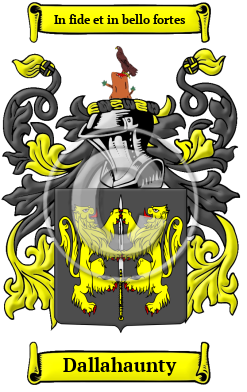
| ![Show Contents]() Dallahaunty History, Family Crest & Coats of Arms Dallahaunty History, Family Crest & Coats of Arms
- Origins Available:
Ireland
Etymology of DallahauntyWhat does the name Dallahaunty mean? In its ancient Gaelic form, the Irish name Dallahaunty was written Ó Dulchaointigh, which comes from the word dulchaointeach, which refers to a satirist. 1 The ancestor of this Irish family is said to have been Muintir Cormac or Muintir Dulchonta, which was gradually anglicized over the years, until it was rendered as Delahunt or Delahunty. Although the name appears quite French, it seems highly unlikely that there are any French origins to the name, other than the Norman influence of the clerks, who began processing Irish names, as early as the 12th century. Early Origins of the Dallahaunty familyThe surname Dallahaunty was first found in Ormond, where records of the name can be found in deeds from around 1441 on. Petty's "census" of 1659 showed bearers of Dallahaunty in counties Offaly (King's county) and Kilkenny. The ancient and important Dallahaunty sept sometimes claims descent from the O'Hara Buidhe, Chiefs of Leyney in County Sligo, through Lughaidh. Early History of the Dallahaunty familyThis web page shows only a small excerpt of our Dallahaunty research. Another 69 words (5 lines of text) covering the years 1670 and 1735 are included under the topic Early Dallahaunty History in all our PDF Extended History products and printed products wherever possible. Dallahaunty Spelling VariationsOne explanation for the many variations is that scribes and church officials frequently spelled the name as it sounded: an imprecise method at best. Understandably then, various spellings of the surname Dallahaunty were found in the many archives researched. These included Delahunt, Delahunty, DeLahunte, DeLaHunty, De-la-Hunt, Delahunt and many more. Early Notables of the Dallahaunty familyMore information is included under the topic Early Dallahaunty Notables in all our PDF Extended History products and printed products wherever possible. Migration of the Dallahaunty familyUnder the rule of England, land ownership in Ireland changed dramatically, and many native Irish families found themselves renting out land to farm from absentee owners. This was one of the prime reasons that immigration to North America began in the late 18th century: Irish farmers dreamed of owning their own parcel of land to work for themselves. At this point, the immigrants were at least of modest means for the passage across the Atlantic was often quite dear. In the 1840s the Great Potato Famine created an exodus of people of quite different means. These people were most often destitute: they either sold anything they had to gain a passage or they were sponsored by philanthropic societies. Many of these immigrants were sick from disease and starvation: as a result many did not survive the long transatlantic journey. Although those settlers that did survive were often despised and discriminated against by people already established in these nations, they were critical to rapid development of the powerful industrial nations of the United States and the country that would later become known as Canada. An examination of immigration and passenger lists shows many persons bearing the name of Dallahaunty or one of its variants: Daniel Delahunty, who came to Maryland in 1749; Rose Delahunt, a bonded passenger who arrived in Maryland in 1755; as well as Lawrence Dulhunty, a Captain in the Royal Garrison Battalion, in 1779.
The motto was originally a war cry or slogan. Mottoes first began to be shown with arms in the 14th and 15th centuries, but were not in general use until the 17th century. Thus the oldest coats of arms generally do not include a motto. Mottoes seldom form part of the grant of arms: Under most heraldic authorities, a motto is an optional component of the coat of arms, and can be added to or changed at will; many families have chosen not to display a motto.
Motto: In fide et in bello fortes
Motto Translation: Firm in faith and war.
- MacLysaght, Edward, The Surnames of Ireland. Ireland: Irish Academic Press, sixth edition, 1985. Print. (ISBN 0-7165-2366-3)
 |