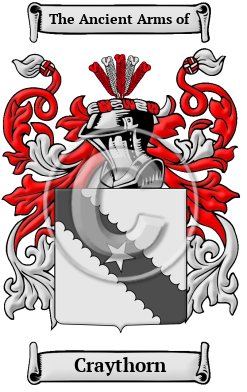
| ![Show Contents]() Craythorn History, Family Crest & Coats of Arms Craythorn History, Family Crest & Coats of Arms
- Origins Available:
England
Early Origins of the Craythorn familyThe surname Craythorn was first found in the North Riding of Yorkshire at Crathorne, a parish, in the union of Stokesley, W. division of the liberty of Langbaurgh. "This place, which is in the district called Cleveland, and situated on the western side of the vale of the river Leven, anciently belonged to the Crathorne family, who were settled here for many generations, and of whom Sir William Crathorne, Knt., died in the early part of the 14th century. The church is a small ancient structure, in the chancel of which is the recumbent effigy of a knight, supposed to be Sir William Crathorne. There is a Roman Catholic chapel, originally founded by the Crathorne family, and rebuilt about 1825." 1 Early History of the Craythorn familyThis web page shows only a small excerpt of our Craythorn research. Another 63 words (4 lines of text) covering the years 1345, 1509, 1670, 1739 and 1740 are included under the topic Early Craythorn History in all our PDF Extended History products and printed products wherever possible. Craythorn Spelling VariationsSpelling variations of this family name include: Crathorne, Crawthorne, Craythorne, Creythorne, Creythorn, Craythorn and many more. Early Notables of the Craythorn familyWilliam Crathorne (1670-1740), English Catholic divine, born in October 1670, descended from the ancient family of Crathorne of Crathorne in Yorkshire. He was educated in the English college at Douay, where he was a professor for several years. On being ordained priest he assumed the...
Another 45 words (3 lines of text) are included under the topic Early Craythorn Notables in all our PDF Extended History products and printed products wherever possible.
| Craythorn migration to Australia | + |
Craythorn Settlers in Australia in the 19th Century- Thomas Craythorn, aged 38, a labourer, who arrived in South Australia in 1855 aboard the ship "Telegraph"
- Lewis, Samuel, A Topographical Dictionary of England. Institute of Historical Research, 1848, Print.
 |