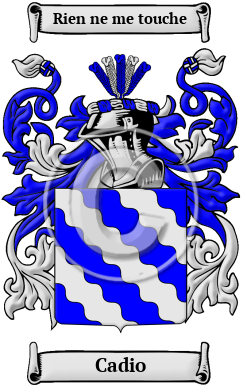
| ![Show Contents]() Cadio History, Family Crest & Coats of Arms Cadio History, Family Crest & Coats of Arms
- Origins Available:
France
Etymology of CadioWhat does the name Cadio mean? The surname is one of the most ancient names that came from France during the Middle Ages. It is a Breton name for a person who was a person who was small but a strong fighter. The name Cadio is derived from the Old French word "cad," which means "little fighter." Early Origins of the Cadio familyThe surname Cadio was first found in Brittany (French: Bretagne), where they are recorded as an ancient family with lands, manors, and estates. The family was involved in many of the early conflicts between French royalty and local Lords regarding the jurisdiction of their lands. A family member by the name of Cadeau d'Arcy would later hold large estates in Picardy and in île-de-France. He became secretary to the King of France and was ennobled by the French Parliament as a viscount on 30th June 1830. Many family members later migrated to Acadia in Canada. Some settled in the province of Quebec, while others left for Louisiana in the forced exodus of the Acadians. Pierre Cadieux, son of Jean and Marie (née Valade), settled in Quebec in the 17th century. He married Marguerite Menard, daughter of Jacques and Catherine (née Fortier), at Boucherville on 11th February 1697. He married for the second time on 29th May 1702 at Pointe-aux-Trembles to Jeanne Mersan. 1 Early History of the Cadio familyThis web page shows only a small excerpt of our Cadio research. Another 57 words (4 lines of text) covering the years 1660 and 1696 are included under the topic Early Cadio History in all our PDF Extended History products and printed products wherever possible. Cadio Spelling VariationsChanges of spelling have occurred in most surnames. The earliest explanation is that during the early development of the French language, names were not yet fixed in spelling. Usually a person gave his version of his name, phonetically, to a scribe, a priest, or a recorder. This depended on accent, and local accents frequently changed the spelling of a name. Some variables were adopted by different branches of the family name. Hence, there are some spelling variations of the name Cadio, including Cadieux, Cadieu, Cadeau, Cadeaux, Cadio, Cadiot, Cadéo, Cadiou, Cadioux, Cadious, Cadius, Cadier, Caduc, Cadel, Cadelon, Cadelard, Cadenel, Cadenet, Cadu, Cado, Cadou, Cadoux, Cadot, Cadotte, Caudos, Caddieux, Caddieu, Caddeau, Caddeaux, Caddioux, Caddiou, Caddious, Caddius, Caddier and many more. Early Notables of the Cadio family- Jean Cadiot, treasurer of France and finance minister in 1696, and the Lords of Parc
Migration of the Cadio familyApproximately 110 years after the first landings by Cartier, there were only about 300 people in Quebec. France gave land incentives for 2,000 migrants during the next decade. Early marriage was desperately encouraged amongst the immigrants. The fur trade attracted migrants, both noble and commoner. 15,000 explorers left Montreal in the late 17th and 18th centuries. By 1675, there were 7000 French in Quebec. Migration to New France (Quebec) continued from France until it fell in 1759. In the year 1675 the Acadian presence in Nova Scotia, New Brunswick and Prince Edward Island had reached 500. In 1755, 10,000 French Acadians refused to take an oath of allegiance to England and were deported to Louisiana. The French founded Lower Canada, thus becoming one of the two great founding nations of Canada. The distinguished family name Cadio has made significant contributions to the culture, arts, sciences and religion of France and New France. Amongst the settlers in North America with this distinguished name Cadio were François Cadieu, 17; who settled in Louisiana in 1719; Pierre Cadieux, who married Marguerite Menard in 1697 in Boucherville, Quebec; Jacques Cadieux, who married Marie Viau in 1731 in Longueuil, Quebec.
The motto was originally a war cry or slogan. Mottoes first began to be shown with arms in the 14th and 15th centuries, but were not in general use until the 17th century. Thus the oldest coats of arms generally do not include a motto. Mottoes seldom form part of the grant of arms: Under most heraldic authorities, a motto is an optional component of the coat of arms, and can be added to or changed at will; many families have chosen not to display a motto.
Motto: Rien ne me touche
Motto Translation: Springing to life, do not touch
- Olivier, Reginald L. Your Ancient Canadian Family Ties. Logan: The Everton Publishers, Inc., P.O. Box 368, 1972. Print
 |